
Größer ist besser - und viel wertvoller!
Ja, Größe ist wichtig - sehr viel. Große Teppiche sind selten, was natürlich den Wert erhöht. Frühere und gegenwärtige Weber weben typischerweise kleine bis mittelgroße Teppiche. Ein Grund ist der begrenzte Platz. Je größer der Teppich, desto größer der Webstuhl. Viele Navajo leben in Häusern mit niedrigen Decken und geringer Fläche, was es vielen Webern fast unmöglich macht, große Teppiche anzunehmen.
Ein weiterer Grund, warum Weber dazu neigen, kleinere Teppiche zu weben, ist die Zeit, die sie benötigen. Die Fertigstellung großer Teppiche kann ein Jahr oder länger dauern. Der Zahltag von Weaver kommt normalerweise, wenn sie ihren Teppich verkaufen. Nur wenige können ein Jahr oder länger ohne Gehaltsscheck auskommen. Das bedeutet, dass damals und heute weniger Weber große Teppiche annehmen.
Wir haben große historische, zeitgenössische und Churro-Webereien zur Verfügung.
Die Preise variieren besonders, wenn Steve ein gutes Geschäft mit dem Weben macht - er gibt diese Einsparungen dann an unsere Kunden weiter.

Große Navajo Teppiche zum Verkauf
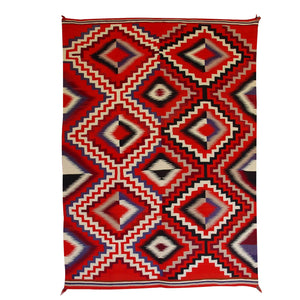
Germantown Optical Navajo Weaving : Historic : GHT 2203 : 49 1/2″ x 68″ (4'1.5" x 5'8")
Germantown
$ 33,000.00
{"id":7563456067,"title":"Germantown Optical Navajo Weaving : Historic : GHT 2203 : 49 1\/2″ x 68″ (4'1.5\" x 5'8\")","handle":"ght-2203-germantown-navajo-rug-circa-1880s","description":"\u003cp\u003e\u003cspan class=\"highlightNode\"\u003eGermantown\u003c\/span\u003e Navajo Rug. Germantown yarn (from \u003cspan class=\"highlightNode\"\u003eGermantown\u003c\/span\u003e Pennsylvania area) was first introduced to the Navajo at Bosque Redondo, so the women would have some material \u003cspan class=\"text_exposed_show\"\u003eto weave their highly prized rugs. The Navajo Indians were allowed to return to their reservation (1868), where the weavers continued to use the popular \u003cspan class=\"highlightNode\"\u003eGermantown\u003c\/span\u003e yarns because they liked working with the vast array of colors. During the early years 1864-1875 \u003cspan class=\"highlightNode\"\u003eGermantown\u003c\/span\u003e yarn was 3 ply and was 4-ply after 1875. This yarn was provided as an annuity by the U.S. Government until 1878, after that the local Traders supplied \u003cspan class=\"highlightNode\"\u003eGermantown \u003c\/span\u003eand other yarns.\u003c\/span\u003e\u003c\/p\u003e\n\u003cdiv class=\"text_exposed_show\"\u003e\n\u003cp\u003eHere we have a piece from this period, woven in the 1880s in MINT condition. It is an exceptional example, finely and tightly woven using \u003cem\u003e \u003cstrong\u003eNavajo Textiles as Modern Art\u003c\/strong\u003e exhibit\u003c\/em\u003e.\u003c\/p\u003e\n\u003cp\u003e\u003cem\u003eThis beautiful piece was featured in the \u003cstrong\u003eNavajo Textiles as Modern Art\u003c\/strong\u003e exhibit held at Nizhoni Ranch Gallery March 11 - June 30 2017. You can find this weaving in the catalog Navajo Textiles As Modern Art on page 6.\u003c\/em\u003e\u003cem\u003e\u003cspan\u003e\u003c\/span\u003e\u003c\/em\u003e\u003c\/p\u003e\n\u003ctable style=\"width: 349.672px;\"\u003e\n\u003ctbody\u003e\n\u003ctr\u003e\n\u003ctd style=\"width: 107px;\"\u003eStyle\u003c\/td\u003e\n\u003ctd style=\"width: 225.672px;\"\u003eGermantown \u003c\/td\u003e\n\u003c\/tr\u003e\n\u003ctr\u003e\n\u003ctd style=\"width: 107px;\"\u003eWeaver\u003c\/td\u003e\n\u003ctd style=\"width: 225.672px;\"\u003eUnknown Navajo\u003c\/td\u003e\n\u003c\/tr\u003e\n\u003ctr\u003e\n\u003ctd style=\"width: 107px;\"\u003eDate\u003c\/td\u003e\n\u003ctd style=\"width: 225.672px;\"\u003ecirca 1880\u003c\/td\u003e\n\u003c\/tr\u003e\n\u003ctr\u003e\n\u003ctd style=\"width: 107px;\"\u003eSize\u003c\/td\u003e\n\u003ctd style=\"width: 225.672px;\"\u003e49 1\/2″ x 68″ (4'1.5\" x 5'8\")\u003c\/td\u003e\n\u003c\/tr\u003e\n\u003ctr\u003e\n\u003ctd style=\"width: 107px;\"\u003eItem #\u003c\/td\u003e\n\u003ctd style=\"width: 225.672px;\"\u003eGHT 2203\u003c\/td\u003e\n\u003c\/tr\u003e\n\u003ctr\u003e\n\u003ctd style=\"width: 332.672px;\" colspan=\"2\"\u003e\u003ca href=\"https:\/\/navajorug-com.myshopify.com\/pages\/germantown\"\u003eLearn more about Germantown weavings\u003c\/a\u003e\u003c\/td\u003e\n\u003c\/tr\u003e\n\u003c\/tbody\u003e\n\u003c\/table\u003e\n\u003cp\u003e\u003cspan\u003eContact us for more information at nizhoniranch@gmail.com \u003c\/span\u003e\u003cspan\u003eor 520-455-5020 -- We will be glad to help you!\u003c\/span\u003e\u003c\/p\u003e\n\u003cp\u003e\u003cspan\u003eNizhoni Ranch Gallery donates a portion of each sale to the \u003ca title=\"Forever Navajo Foundation\" href=\"https:\/\/www.navajorug.com\/pages\/forever-navajo\"\u003eForever Navajo Foundation\u003c\/a\u003e. Forever Navajo's primary purpose is to preserve the fine art of Navajo weaving.\u003c\/span\u003e\u003c\/p\u003e\n\u003c\/div\u003e","published_at":"2016-07-16T14:16:00-07:00","created_at":"2016-07-16T14:16:23-07:00","vendor":"Historic Collection","type":"Germantown","tags":["4 x 5","Antique Navajo Rugs","circa-1880","Filter by Price_$30000 to $40000","Filter by Size_Medium","germantown","medium","modern-art-exhibit","Navajo Rugs","Navajo Rugs by Style_Germantown","Navajo Rugs by Style_Optical","Navajo Rugs by Style_Serape","Navajo Rugs Circa_1880 to 1890","optical","serape","size 4 x 5","Size 4 x 6"],"price":3300000,"price_min":3300000,"price_max":3300000,"available":true,"price_varies":false,"compare_at_price":0,"compare_at_price_min":0,"compare_at_price_max":0,"compare_at_price_varies":false,"variants":[{"id":23862470403,"title":"Default Title","option1":"Default Title","option2":null,"option3":null,"sku":"","requires_shipping":true,"taxable":true,"featured_image":null,"available":true,"name":"Germantown Optical Navajo Weaving : Historic : GHT 2203 : 49 1\/2″ x 68″ (4'1.5\" x 5'8\")","public_title":null,"options":["Default Title"],"price":3300000,"weight":0,"compare_at_price":0,"inventory_quantity":1,"inventory_management":"shopify","inventory_policy":"deny","barcode":null,"requires_selling_plan":false,"selling_plan_allocations":[],"quantity_rule":{"min":1,"max":null,"increment":1}}],"images":["\/\/www.navajorug.com\/cdn\/shop\/products\/GHT_2203.jpg?v=1579875020","\/\/www.navajorug.com\/cdn\/shop\/products\/Germantown-drape-600x570.jpg?v=1579875020","\/\/www.navajorug.com\/cdn\/shop\/products\/Germantown-Navajo-Rug-600x487.jpg?v=1579875020","\/\/www.navajorug.com\/cdn\/shop\/products\/GHT-2203-600x789.jpg?v=1579875020","\/\/www.navajorug.com\/cdn\/shop\/products\/DSC00028-600x450.jpg?v=1579875020","\/\/www.navajorug.com\/cdn\/shop\/products\/DSC00029-600x450.jpg?v=1579875020"],"featured_image":"\/\/www.navajorug.com\/cdn\/shop\/products\/GHT_2203.jpg?v=1579875020","options":["Title"],"media":[{"alt":"A Germantown Navajo rug featuring a geometric pattern with prominent red colors, circa 1880, very rare.","id":89232375880,"position":1,"preview_image":{"aspect_ratio":1.0,"height":1600,"width":1600,"src":"\/\/www.navajorug.com\/cdn\/shop\/products\/GHT_2203.jpg?v=1579875020"},"aspect_ratio":1.0,"height":1600,"media_type":"image","src":"\/\/www.navajorug.com\/cdn\/shop\/products\/GHT_2203.jpg?v=1579875020","width":1600},{"alt":"A Germantown Navajo rug featuring a geometric pattern with prominent red colors, circa 1880, very rare.","id":89232408648,"position":2,"preview_image":{"aspect_ratio":1.053,"height":570,"width":600,"src":"\/\/www.navajorug.com\/cdn\/shop\/products\/Germantown-drape-600x570.jpg?v=1579875020"},"aspect_ratio":1.053,"height":570,"media_type":"image","src":"\/\/www.navajorug.com\/cdn\/shop\/products\/Germantown-drape-600x570.jpg?v=1579875020","width":600},{"alt":"A Germantown Navajo rug featuring a geometric pattern with prominent red colors, circa 1880, very rare.","id":89232441416,"position":3,"preview_image":{"aspect_ratio":1.232,"height":487,"width":600,"src":"\/\/www.navajorug.com\/cdn\/shop\/products\/Germantown-Navajo-Rug-600x487.jpg?v=1579875020"},"aspect_ratio":1.232,"height":487,"media_type":"image","src":"\/\/www.navajorug.com\/cdn\/shop\/products\/Germantown-Navajo-Rug-600x487.jpg?v=1579875020","width":600},{"alt":"A Germantown Navajo rug featuring a geometric pattern with prominent red colors, circa 1880, very rare.","id":89232474184,"position":4,"preview_image":{"aspect_ratio":0.76,"height":789,"width":600,"src":"\/\/www.navajorug.com\/cdn\/shop\/products\/GHT-2203-600x789.jpg?v=1579875020"},"aspect_ratio":0.76,"height":789,"media_type":"image","src":"\/\/www.navajorug.com\/cdn\/shop\/products\/GHT-2203-600x789.jpg?v=1579875020","width":600},{"alt":"A Germantown Navajo rug featuring a geometric pattern with prominent red colors, circa 1880, very rare.","id":89232506952,"position":5,"preview_image":{"aspect_ratio":1.333,"height":450,"width":600,"src":"\/\/www.navajorug.com\/cdn\/shop\/products\/DSC00028-600x450.jpg?v=1579875020"},"aspect_ratio":1.333,"height":450,"media_type":"image","src":"\/\/www.navajorug.com\/cdn\/shop\/products\/DSC00028-600x450.jpg?v=1579875020","width":600},{"alt":"A Germantown Navajo rug featuring a geometric pattern with prominent red colors, circa 1880, very rare.","id":89232539720,"position":6,"preview_image":{"aspect_ratio":1.333,"height":450,"width":600,"src":"\/\/www.navajorug.com\/cdn\/shop\/products\/DSC00029-600x450.jpg?v=1579875020"},"aspect_ratio":1.333,"height":450,"media_type":"image","src":"\/\/www.navajorug.com\/cdn\/shop\/products\/DSC00029-600x450.jpg?v=1579875020","width":600}],"requires_selling_plan":false,"selling_plan_groups":[],"content":"\u003cp\u003e\u003cspan class=\"highlightNode\"\u003eGermantown\u003c\/span\u003e Navajo Rug. Germantown yarn (from \u003cspan class=\"highlightNode\"\u003eGermantown\u003c\/span\u003e Pennsylvania area) was first introduced to the Navajo at Bosque Redondo, so the women would have some material \u003cspan class=\"text_exposed_show\"\u003eto weave their highly prized rugs. The Navajo Indians were allowed to return to their reservation (1868), where the weavers continued to use the popular \u003cspan class=\"highlightNode\"\u003eGermantown\u003c\/span\u003e yarns because they liked working with the vast array of colors. During the early years 1864-1875 \u003cspan class=\"highlightNode\"\u003eGermantown\u003c\/span\u003e yarn was 3 ply and was 4-ply after 1875. This yarn was provided as an annuity by the U.S. Government until 1878, after that the local Traders supplied \u003cspan class=\"highlightNode\"\u003eGermantown \u003c\/span\u003eand other yarns.\u003c\/span\u003e\u003c\/p\u003e\n\u003cdiv class=\"text_exposed_show\"\u003e\n\u003cp\u003eHere we have a piece from this period, woven in the 1880s in MINT condition. It is an exceptional example, finely and tightly woven using \u003cem\u003e \u003cstrong\u003eNavajo Textiles as Modern Art\u003c\/strong\u003e exhibit\u003c\/em\u003e.\u003c\/p\u003e\n\u003cp\u003e\u003cem\u003eThis beautiful piece was featured in the \u003cstrong\u003eNavajo Textiles as Modern Art\u003c\/strong\u003e exhibit held at Nizhoni Ranch Gallery March 11 - June 30 2017. You can find this weaving in the catalog Navajo Textiles As Modern Art on page 6.\u003c\/em\u003e\u003cem\u003e\u003cspan\u003e\u003c\/span\u003e\u003c\/em\u003e\u003c\/p\u003e\n\u003ctable style=\"width: 349.672px;\"\u003e\n\u003ctbody\u003e\n\u003ctr\u003e\n\u003ctd style=\"width: 107px;\"\u003eStyle\u003c\/td\u003e\n\u003ctd style=\"width: 225.672px;\"\u003eGermantown \u003c\/td\u003e\n\u003c\/tr\u003e\n\u003ctr\u003e\n\u003ctd style=\"width: 107px;\"\u003eWeaver\u003c\/td\u003e\n\u003ctd style=\"width: 225.672px;\"\u003eUnknown Navajo\u003c\/td\u003e\n\u003c\/tr\u003e\n\u003ctr\u003e\n\u003ctd style=\"width: 107px;\"\u003eDate\u003c\/td\u003e\n\u003ctd style=\"width: 225.672px;\"\u003ecirca 1880\u003c\/td\u003e\n\u003c\/tr\u003e\n\u003ctr\u003e\n\u003ctd style=\"width: 107px;\"\u003eSize\u003c\/td\u003e\n\u003ctd style=\"width: 225.672px;\"\u003e49 1\/2″ x 68″ (4'1.5\" x 5'8\")\u003c\/td\u003e\n\u003c\/tr\u003e\n\u003ctr\u003e\n\u003ctd style=\"width: 107px;\"\u003eItem #\u003c\/td\u003e\n\u003ctd style=\"width: 225.672px;\"\u003eGHT 2203\u003c\/td\u003e\n\u003c\/tr\u003e\n\u003ctr\u003e\n\u003ctd style=\"width: 332.672px;\" colspan=\"2\"\u003e\u003ca href=\"https:\/\/navajorug-com.myshopify.com\/pages\/germantown\"\u003eLearn more about Germantown weavings\u003c\/a\u003e\u003c\/td\u003e\n\u003c\/tr\u003e\n\u003c\/tbody\u003e\n\u003c\/table\u003e\n\u003cp\u003e\u003cspan\u003eContact us for more information at nizhoniranch@gmail.com \u003c\/span\u003e\u003cspan\u003eor 520-455-5020 -- We will be glad to help you!\u003c\/span\u003e\u003c\/p\u003e\n\u003cp\u003e\u003cspan\u003eNizhoni Ranch Gallery donates a portion of each sale to the \u003ca title=\"Forever Navajo Foundation\" href=\"https:\/\/www.navajorug.com\/pages\/forever-navajo\"\u003eForever Navajo Foundation\u003c\/a\u003e. Forever Navajo's primary purpose is to preserve the fine art of Navajo weaving.\u003c\/span\u003e\u003c\/p\u003e\n\u003c\/div\u003e"}
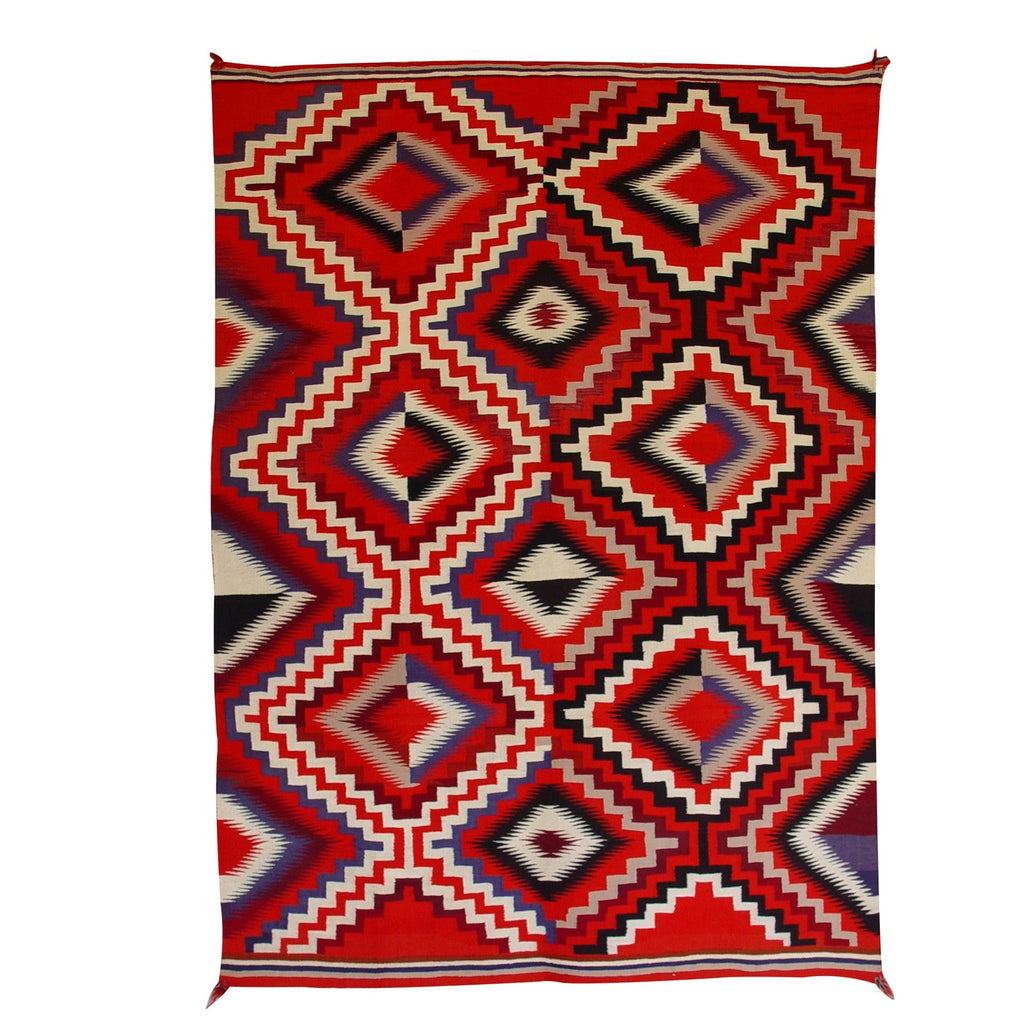
Germantown Optical Navajo Weaving : Historic : GHT 2203 : 49 1/2″ x 68″ (4'1.5" x 5'8")
$ 33,000.00
Germantown Navajo Rug. Germantown yarn (from Germantown Pennsylvania area) was first introduced to the Navajo at Bosque Redondo, so the women would have some material to weave their highly prized rugs. The Navajo Indians were allowed to return to their reservation (1868), where the weavers continued to use the popular Germantown yarns because t...


