

IMMER versandkostenfrei in den USA !!

About Us and Press

RSS
Western Art Collector - Pieces of the Past - February 2014

Western Art Collector - Pieces of the Past - February 2014


For ease of reading online……


Western Art Collector Special Section Article February 2014
 PIECES OF THE PAST
Collecting Historic Native American Art

Historic Native American art is as diverse as the tribes and artisans who created it.  From intricate weaving designs, detailed pottery, and complex baskets to storage jars and everything in between, these works created over thousands of years developed into several distinctive styles.  These culturally rich works are not only beautiful but are infused with history and tell a story.

Today, collectors are finding numerous options when it comes to buying and selling historic Native American art.  Major art shows like the Marin Show: Art of the Americas offer space to presenting fine antique works, while important auction houses across the country like Bonhams, Cowan’s Auctions, and Heritage Auctions dedicate yearly sales to the finest in historic American Indian art.  When collections are re-discovered and offered is an exciting chance for a new generation of collectors.

Available works that are complete with provenance provide a snapshot of the era in which they are made.  Collecting historic Native American art can be a lifelong pursuit of education, preservation, and imagination – and even a little bit of adventure – to unravel the stories inherent in these works.  Galleries in Tucson, Scottsdale, Santa Fe, and even Los Angeles are finding that collectors are eager to purchase work that is new to the market.  And, like most art, quality will always sell.  Diversity in subject matter and style adds to the desirability of these historic works, and modern versatility makes these pieces captivating to viewers.

One of the wonderful things about historic Native American art is that it blends nicely in very traditional homes, but certain pieces blend very well with contemporary and modern homes.  Whether it’s a Black Maria pot or a stark double saddle blanket, these accentuate contemporary homes with the simplicity of the design.  You can still have the most traditional of Native American objects in a more Southwest traditional home.

The Native Americans of the Southwest have always intrigued, impressed and fascinated Steve Getzwiller and his wife Gail.  For 40 years they have promoted Navajo weaving and provided collectors with some of the finest artworks the indigenous peoples of North America have ever created.  Steve Getzwiller says he recently found two outstanding Apache and Pima basket collections. “Our selection of Navajo weavings is the strongest it has ever been,” he adds.

Getzwiller invites visitors to visit the gallery by emailing or calling to arrange a time.  They will open the gate, contain the guard dogs and maybe even put the horses out to greet visitors, who will be stunned at the breathtaking views around the ranch house and by the Getzwiller’s impressive collection of artwork.


  • Beth Barth
Western Art Collector - Artist Focus : Elsie Bia - Following Family Traditions - March 2015

Western Art Collector - Artist Focus : Elsie Bia - Following Family Traditions - March 2015

 Artist Focus: Master Weaver Elsie Bia 


For ease of reading online……


Following family traditions 

Elsie Bia hails from the Chinle area of the Navajo Reservation and is one of the last of many generations of master weavers.  Her family herds sheep on the land overlooking Spider Rock in Canyon de Chelly, among the most sacred places in the center of Navajo country. 

The very depth of her work is awe-inspiring.  It seems that there is virtually nothing she can’t accomplish geometrically when singing her songs at the loom. 

Elsie, an award-winning weaver, learned the tradition and techniques from her grandmother, as most youngsters do.  She is in good company, as some of her relatives are also famous weavers; Ruth Ann Tracy, Irene Bia, Helen Bia, Ellen and Lucy Begay.  The talent of this family is apparent in the design and tightness of the weave, often complex – always elegant. 

Elsie carries on the 400-year tradition and artwork of the Navajo and recently joined the famous Navajo Churro Collection Legacy.  Elsie’s Churro Collection weavings are featured at the Nizhoni Ranch Gallery in Sonoita, Arizona. 

Navajo weavings have been made on the same traditional upright loom throughout history. The continuous warp is wrapped by hand on the upright loom, and the design, or weft, is meticulously laid in by hand.  The designs magically emerge with color and symmetry, one strand of wool at a time.  Elsie’s weavings are some of the finest examples you will see today.  They display beautifully on the wall and would last for decades on the floor.

  • Beth Barth
City Sun Times: Take A Trip To The Past: Nizhoni Ranch Gallery - Sep 2014

City Sun Times: Take A Trip To The Past: Nizhoni Ranch Gallery - Sep 2014


For Online Reading Ease:

Take A Trip To The Past:  Nizhoni Ranch Gallery
By Susan Sorg


September 2014

A trip to the Nizhoni Ranch Gallery is more than a drive to Sonoita.  It’s a journey into the proud heritage and culture, reaching back centuries through timeless fiber arts.  Experience the finest in Navajo weavings, presented by a man who knows it best and is considered the country’s leading expert in this field: Steve Getzwiller with more than 40 years of experience working with the finest of Navajo weavers, he’ll guide visitors through a dazzling display of rugs, blankets and “wearable art.”

The Nizhoni Ranch Gallery collection is direct from the land of the Navajo to Sonoita, painstakingly handmade by artists whose families have followed the traditions of weavers for generations.  Now, their work, their creations made in the shadows of Monument Valley and other regions of the Navajo reservation can become part of another family’s home.

In this hilltop setting overlooking the rolling grasslands of Sonoita, one is not far from longtime cattle ranches going back to Arizona territorial days.  It’s the perfect setting for viewing antique saddle blankets and other vintage weavings.  The Nizhoni Ranch Gallery offers the finest and largest selection of historic Navajo weavings, including saddle blankets, Chief’s blankets, and other weavings dating from the late 1800s to 1940s.

Visits are always welcome, but please call ahead to reserve a time to explore this Native American art as only Steve Getzwiller and the Nizhoni Ranch Gallery can show you.  Call 520-455-5020 for times and directions, and check out some of the latest gallery finds.

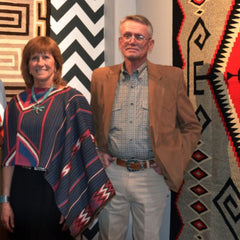
Pictured: Master weavers Elsie Bis, Gloria Hardy and Cara Gorman at Canyon de Chelly with their 2014 award—winning Navajo Weavings.


  • Beth Barth
Quail Creek Crossing - An Expert Share the story of Navajo Rugs - September 2017

Quail Creek Crossing - An Expert Share the story of Navajo Rugs - September 2017


An expert shares the story of Navajo Rugs

Green Valley News - Quail Creek Crossing - September 2017


The upcoming Quail Creek Kino Lecture Series will premier with a talk by Navajo rug expert Steve Getzwiller of Nizhoni Ranch Gallery in Sonoita, on Monday, October 9, 2017, from 7:00-8:00 p.s. in the Quail Creek Madera Ballroom in Green Valley.

As one of the country's top collectors, dealers and experts, Steve will share his extensive knowledge of Navajo rugs, their history, styles and current trends.

Bringing examples, Steve will illustrate and explain the connection between the art of Navajo rug weaving and the artists behind both traditional and contemporary weavings.

Since obtaining his first rug at the age of 18, Steve Getzwiller has made it his life’s work to preserve and foster the art of Navajo rug weaving. He currently sponsors talented weavers ranging in age from 17 to 90; weavers he has worked with over decades and whom he regards as family. Through collaborative efforts, they have set high standards, increased sales and improved marketing. Steve has also purchased a flock of Churro sheep for a family of weavers to have access to the wool traditionally used by the Navajo. The flock is currently being tended by a Navajo family.

In addition to supplying a source of high quality wool, Steve purchases only the best dyes traditionally used by the Navajo: cochineal and indigo as well as contemporary dyes from Switzerland. By meeting Steve’s high standards, his weavers have repeatedly won first place honors at the Gallup Inter-Tribal Ceremonial competition held each year in August.

Steve Getzwiller's visit is cosponsored by the Women of Quail Creek (TWOCQ) Scholarship Committee and the Quail Creek Education Committee. Proceeds from the sale of the tickets will go to TWOCQ's Scholarship Fund. This fund annually sponsors scholarships for senior girls at the two Sahuarita Unified District High Schools and supports Women in Transition returning to school to pursue educational goals.

Ticket information

  • Beth Barth
Wearable Art

Wearable Art

Native American Art Magazine April/May 2019
April 1st, by Susan Sorg

Wearable Art

A look at the Navajo Poncho Serape from its early beginnings through today.

When does clothing go from something worn or put on without thinking, everyday part-of-your-life clothing to becoming something artistic, as in “wearable art”?  And, it has a rich history.  For those who deal in it or collect it, the answer is easy: something created by a Navajo weaver.

Take the poncho, for example.  No, not one of those waterproof ones you see at an outdoor sporting event or even the ones some of us who came of age during the late 60s wore along with our bell-bottomed jeans.  Ponchos have been around for centuries, and believed to have originated in South America along the Andes.  Spanish conquistadores most likely were the first Europeans to see them on this side of the Atlantic and took them back home.  The style also migrated north into Mexico, then further north into what’s now the American southwest.

Scholars generally agree Navajo weaving was likely established in 1650, but wasn’t well known until around 1800.  The “Classic” phase is from 1800 to 1865 while “Late Classic” picks up in 1865 and continues until 1880.  It’s during the Classic period when Navajo weaving was becoming more prominent, not just among different tribes, but also among U.S. soldiers, traders, cowboys, and other adventurous souls heading west.  A poncho created by a Navajo weaver was considered a high-end status symbol.

“A poncho was as expensive as a house back then.  It would take a couple years to make,” says Jeff Voracek, owner of Red Mesa Gallery in Penryn, California. 

“The highest documented price for a Navajo weaving was allegedly, something in the 1850s that sold for $500,” he adds.  “$50 to $100 was what it cost you to get a good blanket.  And a poncho would certainly be on the high side of that.   It was for the person who could afford it” 

Joyce Begay-Foss, the outreach director for the Museum of Indian Arts and Culture in Santa Fe agrees ponchos and other historic wearable items created by Navajo weavers were of high quality.

“Ponchos were made for people as a high trade item, sometimes those in the military, people who served in the infantries traded for them,” she says, adding other weavings such as Chief Blankets, were also highly thought of and sought after.

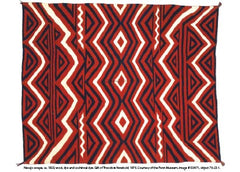
Two examples of high quality ponchos from the Classic/ Late Classic periods are now thousands of miles apart.  One is in Philadelphia, in the University of Pennsylvania Museum of Anthropology and Archeology.  Experts believe it was woven approximately 1850, using handspun wool yarn, of white and dark blue, dyed in indigo, as well as bayetta (raveled worsted) which gets its deep red from cochineal.  The zig-zag design is often referred to as a snake pattern.

navajo serape Penn Museum


According to William Wierzbowski who is with the museum, the poncho was donated decades ago.  “It was gifted to us in 1976 by Ted Newbold, a Philadelphian who was involved in arts and culture,” Wierzbowski writes.  “It was part of his first wife’s family summer cottage décor in northern Michigan but I recall him telling me that they had no idea how her family acquired it.” 

Meanwhile, back in the southwest another poncho resurfaced only a few years ago, this time in New Mexico.  It passed down through a family in Albuquerque, and was brought to the attention of Steve Getzwiller, collector and owner of Nizhoni Ranch Gallery in Sonoita, Arizona.  “A picker friend of mine found it, and I got first shot at it even though half a dozen other dealers wanted it,” he explains.

PC 256 poncho serape
PC 256, Classic Poncho Serape, circa 1860, 55" x 78" - call for pricing

“It’s in absolutely mint condition,” he continues.  “And it’s got the same snake pattern as the one in the Philadelphia museum has.”  Getzwiller firmly believes his poncho, which he thinks was made in the mid-1860s, came from the same weaver.  Others, who have seen only photos of Getzwiller’s weaving, say the similarities are strong, and it could certainly be from the same weaving family.

Gallery owner Jeff Voracek who has handled it says similarities of the two pieces are not by accident.  “When you’re that good of a weaver, you wouldn’t be copying anybody else,” he says.  “It’s very similar, it’s not a copy whatsoever, and it’s unique.  I would call it the fingerprint of the prior weaver.”

Voracek also believes Getzwiller’s poncho could have been made later, more like early 1870s, citing the deep purple used in the piece instead of indigo blue, saying it was a new color for Navajo weavers.  “When they got packet dyes, they went wild with them.  And packet dyes are there in the (18)70s.  So in this blanket that Steve has, it’s got purple bayetta in it, a really fine diameter purple bayetta,”   And, Voracek says he has not seen purple in any other weaving like this.

The Classic and Late Classic periods was ripe with other variations of “wearable art”, with dazzling blankets made to be worn with pride.  Instead of the Spanish name sarapes, Begay-Foss prefers to call them “shoulder blankets.”  These pieces are woven vertically, and created in many, many sizes.

“They have a very fine warp and weft count,” she says.  “The piece is so tightly woven, they’re known for warmth and nearly waterproof.”  That also added to their durability and value.  Who wouldn’t want something which kept you warm and dry through the often harsh and changeable seasons in the higher altitudes of northern New Mexico and Arizona?

“It’s warm.  You can sleep with it, you can walk with it, and you can do anything with it on.  It was like that,” says master weaver Kathy Marianito.  “This was different yarn, thicker yarn, and it makes it a thicker blanket and poncho, and things like that.”

“One thing to remember,” says Joyce Begay-Foss, “this was during the period of the Long Walk, when the government marched the Navajos out, in 1863, and then when they came back in 1868.  This was within that time frame.  We have these master pieces of weaving…that’s what sustained our people, with these amazing woven pieces.”

The Navajos were literally herded off their lands, walking hundreds of miles to Bosque Redondo in New Mexico.  It was a horrific time for them but one in which their culture grew stronger with resolve and ingenuity.  The weaving continued, with an assortment of materials such as commercial yarn, which weavers got from the government.  They also had bayetta, which is usually commercial cloth and often times flannel which was then unraveled.  While bayetta came in virtually every color it was often times red when they got it, or else dyed red with cochineal.

Whatever the material, Navajo pieces made during the Classic and Late Classic years were quite simply stunning.  These are the years leading up to the Long Walk, followed by the time at Bosque, and afterwards when weaving of ponchos and wearable blankets increased.  A perfect example are Chief Blankets, as praised by scholar Joe Ben Wheat in a 1976 article, when he called it “one of the finest achievements in Navajo weaving.”  Simple, and yet made with the best materials to be found by the best weavers, these were expensive and considered a status symbol to own.

“They were woven for people of prominence, Chief Blankets,” says Begay-Foss, who also points out the irony of the name for this type of wearing blankets.  “We don’t have chiefs…we have leaders, ‘Nataaniis’.”

One of those early leaders, Manuelito and his wife Juanita, who was a master weaver in her own right, helped in the negotiations to end the time of the Diné, the Navajo people at Bosque.  In 1868, the Navajos finally returned to their native lands, becoming one of the few tribes to achieve that.  However, this painful exile with the Long Walk remains seared in their history.

It was during this time another type of “wearable art” came to be, and those are blankets, serapes, with a “Spider Woman hole.”  Spider Woman is one of the primary deities in the Navajo culture.  Legends say it was she who taught the Navajos to weave, and in some of the older blankets in the 19th century, a small slit was left, a hole like in the center of a spider web, to acknowledge what Spider Woman did for the people.  Others say the small hole in the center of a blanket, a sarape, had another purpose.

“They used to peek through it, and hide behind and see soldiers when they were coming and what have you,” says Steve Getzwiller.  “That’s the story I’ve heard but that’s more in the line with conjecture.”

A Spider Woman hole is in the center of one weaving he’s owned for decades.  This serape defies the odds and rules when it comes to determining ages of historic Navajo textiles.  Getzwiller says the colors used were those only found at Bosque.  And yet the design, with serrate prominent on the diagonal stripes, is thought to have originated much later.

PC 258  This is a serape that has a Spider Woman Hole woven into the center, it's about 2"
PC 258,  Serape Blanket, 3 ply Saxony with natural dyes - call for pricing

Getzwiller says some of the weaving is done with 3-ply Saxony yarn, again something usually found in Late Classic.  There’s also two shades of red, out of 4-ply yarn, as Voracek discovered…and that’s not all. 

“When you have something with 4-ply in it, that would typically be 1880s,” Voracek says.  “But he happens to have one that has two shades of 4-ply and one’s a red and one’s more of a pinker red, and they’ve both been tested twice as cochineal….and cochineal stops in the 1870’s.”

Then there’s the design, serrate, or knife edge, the diagonal stripes which come to a point and was usually seen in the 1870s or later.  “There were pieces collected at Massacre Cave that had serrate on it,” Voracek continues.  “That was close to (the year) 1800, so we know they had the ability to do them…but most of the time they didn’t.”

Voracek also remembers a conversation he had with Steve Getzwiller giving yet another element to the legends behind adding a Spider Woman hole to weavings.

“It’s purported by Steve, from talking to relatives of Bosque survivors that it was something they incorporated if they have survived Bosque,” Voracek says.  “If they had went through Bosque, or during or right after, when you see the Spider Woman holes that was like a statement:  ‘I was there.  I survived it.’”

Voracek also believes there to be far fewer weavings with Spider Woman holes than there are actual ponchos which have survived this long.  Ironically, Navajo woven ponchos are starting to come back, and it’s through the great-great granddaughter of Manuelito and Juanita:  Kathy Marianito, who says some of the designs were passed down to her. 

“The design,” she says, “I had to wait for it, and I don’t want anyone to copy it.”

serape Poncho Navajo Weaving : Kathy Marianito : Churro 1450 : 35″ x 60″ - Getzwiller's Nizhoni Ranch Gallery

Serape Poncho Navajo Weaving : Kathy Marianito : Churro 1450 : 35″ x 60″ 

“The silk wool blend piece that Kathy did, it’s the first poncho serape to come off a Navajo loom in 100 years,” says Getzwiller, taking about a poncho Marianito wove a few years ago with Spider Woman crosses on it.


silk wool blend by Kathy Marianito

Marianito, who says she gets many of her designs from her dreams, points out how anyone can get a jacket in a store.  “They’re machine made, even the way they color it now, and it’s the yarn, machine yarn.  They use our designs now, even the moccasins, paper towels, design on it.”

But to weave something you wear?  Now that brings joy, along with pride to the weaver.  It is part of Marianito’s DNA, her family tree going back to Juanita, much like designs of earlier weavings carried down into future ones which she still dreams of.

“That’s the way I am,” she says.  “It makes me happy and makes me proud of myself.  I love to do that…I don’t know how to describe it any (other) way.”

“That was my dream,” she continues, “something that I’m going to make, and make it into a magazine, or something that I made to look at.  Someday they’re going to look at it, and then my grand kids are going to say ‘This is my grandmother’s.  She made it like this’ and they’ll carry it on.”

  • Beth Barth
Nizhoni Ranch Gallery is Previewed in Native American Art Magazine

Nizhoni Ranch Gallery is Previewed in Native American Art Magazine

GALLERY PREVIEWS
THROUGH FEBRUARY 2020 | NIZHONI RANCH GALLERY | SONOITA, AZ

Transitions

On view now at Nizhoni Ranch Gallery in Sonoita, Arizona, are approximately 50 transitional weavings that are available for purchase.

In the last part of the 19th century as trading posts began to open and lure consumers who were visiting the Western United States, there was a shift in the Native American art market from creating wearing blankets to weaving floor rugs. This period, which spanned approximately 40 years, from the 1880s to the 1910s, has become known as the transitional period with the textiles made by Navajo weavers reflecting the same name.Jellybean transitional blanket, ca. 1880s, handcrafted, hand-spun, Native wool, aniline dyes.

On view now at Nizhoni Ranch Gallery in Sonoita, Arizona, are approximately 50 transitional weavings that are available for purchase. The appointment-only gallery will highlight the work that has become recognized for its beautiful wool, out of the box designs and having an ideal price point for collectors.Transitional pictorial of medicine bags, ca. 1900, positive/negative design, hand-carded, hand-spun, hand-dyed Merino wool, aniline dyes.

Optical art Crystal transitional blanket, ca. 1900, hand-carded, hand-spun, Merino wool with aniline red dye.

“In the late 1880s, a trader by the name of J.B. Moore arrived on the reservation. He recognized there was a demand for floor rugs. Moore began working closely with weavers, influencing them to ‘transition’ from weaving blankets to weaving rugs,” says the gallery’s owner Steve Getzwiller. Moore created a catalog that included a number of designs, known as plates, that the artists would replicate or create their own variations.A circa 1900 transitional J.B. Moore Navajo rug, plate #XII with native wool on view at Nizhoni Ranch Gallery.

Included in the exhibition are several of these examples, such as a circa 1900 textile featuring plate #XII and a transitional weaving from the Crystal area that is a variant of plate #V, also from around 1900.

“Transitional rugs do have specific attributes. The wool was made from Merino and Churro sheep and other native wool,” Getzwiller explains. “The wool was hand-carded, hand-dyed with a thick/heavy spin appropriate for use on the floor. In the transitional period Navajo had access to man-made dyes in bright colors. Weavers loved the new bright colors.”Transitional Navajo textile, ca. 1900, hand-carded, hand-spun Merino wool, aniline red dye with indigo blue.

One of the major highlights of the exhibition is a jellybean transitional blanket, circa 1880s. The piece, which Getzwiller says has “outrageous color and design,” features a zigzag style pattern in oranges, reds and greens. Also in the show is an optical art Crystal transitional blanket from circa 1900 and a transitional pictorial of medicine bags from around 1900. Churro sheep pictorial, ca. 1910, hand-carded, hand-spun all-natural Churro wool.

A circa 1910 Churro sheep pictorial is another textile of note in the show. According to Getzwiller, as the pictorial is of a two-toned sheep in natural wool, “This transitional was probably a memorial weaving to the ‘old sheep’ used for weaving classical blankets.”

The exhibition will remain on view in the gallery through February 2020. —

Nizhoni Ranch Gallery
Through February 2020
Sonoita, AZ 85637
(520) 455-5020 • www.navajorug.com


  • Beth Barth
Color Riot at the Heard Hits the Road

Color Riot at the Heard Hits the Road

Congratulations to Color Riot at the Heard!  This exhibit has been so well received it is has been requested by 3 other museums.  If you were not able to see the show, hopefully you are near one of the following museums:


Museum of Fine Arts, St. Petersburg, Florida
September 5, 2020 - November 22, 2020


Birmingham Museum of Art, Birmingham, Alabama
April 11, 2021 - August 8, 2021


Montclair Art Museum, Montclair, New Jersey
September 10, 2021 - January 2, 2022


Nizhoni Ranch Gallery is proud 14 of our weavings are part of this excellent exhibit!

Heard Museum Color Riot exhibit American Indian Rugs and Blankets


Heard Museum Color Riot exhibit American Indian Rugs and Blankets


Heard Museum Color Riot exhibit American Indian Rugs and Blankets


Heard Museum Color Riot exhibit American Indian Rugs and Blankets


  • Beth Barth
Nizhoni Ranch Gallery Featured in Floor Coverings Today, May 2018

Nizhoni Ranch Gallery Featured in Floor Coverings Today, May 2018

Nizhoni Ranch offers handmade woven rugs

Monday, May 07, 2018
By Caroline Alkire

Navajo rug ganado klagetoh nizhoni ranch gallery

This Ganado-Klagetoh weaving was created by Navajo Master Weaver Rita Clah.


[Sonita, Ariz.] Woven rugs are wonderfully unique, and while they are (of course) great for spring and summer décor, these rugs are more than just a floor covering — they're art. 

No one understands this concept better than Steve and Gail Getzwiller, who, drawn to the beauty and complexity of woven rug design, began meeting with Native American weavers in the 1970's. Steve listened to their stories and soon started collecting Navajo rugs.

In the months following Steve was able to create a business out of his passion, and Gail started a website to grow it. In 2000, the Getzwillers opened up Nizhoni Ranch Gallery in southern Arizona. The ranch now sells handmade Navajo rugs.

"First and foremost, the differences between a rug made on a machine and one woven by hand cannot be overstated. Classic or contemporary, Navajo weavings will last through many years of use, as opposed to a machine-made rug," explained Steve. 

"Navajo Rugs are handmade with the spirit of the Mother Earth and the Navajo People,” explained Gail. “Navajo Rugs bring a peaceful spirit into your home."

Below, FCW has outlined a few of the rugs Nizhoni Ranch carries.
Navajo Rug Nizhoni Ranch Gallery
The Churro 1518, woven in the fashion of an Old Style Crystal, was created by Navajo Master Weaver Elsie Bia and is the second place 2017 Gallup Inter-Tribal Ceremonial award winner.


"The Moki Blanket offers a unique narrow striped styling that generally alternates between dark blue and black or brown rhythmic banding," explained Gale. "One of the most historic Navajo weavings, they’ve been in use since the early 1700's."


Nizhoni Ranch Gallery Navajo Rugs
Nizhoni Ranch Gallery, located in Sonoita, Ariz., features rugs, weavings and pottery handcrafted by Navajo Master Weavers.


See more Navajo style woven rugs on Instagram:

  • Ben Schmid
Forbes Magazine:  Navajo Rug Gallery Weaves Ancient Art And New Technology Together With Bitcoin

Forbes Magazine: Navajo Rug Gallery Weaves Ancient Art And New Technology Together With Bitcoin

Navajo Rug Gallery Weaves Ancient Art And New Technology Together With Bitcoin

Steve Getzwiller is a 7th generation rancher who grew up just east of Tucson, Arizona. As a child, he spent a lot of time at the Amerind Foundation in Dragoon AZ, a museum and research center for Native American arts and culture. Inspired by the director of the foundation, Archaeologist Charles C. Di Peso, Getzwiller went on to study anthropology at the University of Arizona, and became a potter and turquoise trader. But his real passion was Navajo Rugs, and as soon as he could afford to, he became collecting them and wholesaling rugs to top galleries around the U.S. to be able to afford more expensive ones for himself.

In 1995, Getzwiller launched an online website, and in 2000, he opened his own physical gallery, The Nizhoni Ranch Gallery, in Sonoita, AZ. Today, he does about $1 Million of business a year, half through the website and half through his physical store. Getzwiller's Navajo rugs are sold around the world to collectors, business people and rock stars.

Steve Getzwiller Forbes Article Nizhoni Ranch Gallery 2018
Steve Getzwiller, Owner of Nizhoni Ranch Gallery

The Personal Touch

Navajo weavers today are carrying on a 300-year-old tradition of weaving blankets and rugs. Their unique upright loom uses a traditional weaving technique that cannot be mechanized. The loom is warped with one continuous wool thread and the weft is woven through it, one thread at a time. “It is a very time consuming and meticulous process,” Getzwiller explains, “Small rugs can take a full week to weave, while larger Navajo rugs can take years to complete.”

 Master Weaver Cecelia Nez Forbes Nizhoni Ranch Article 2018
Navajo weaver Cecelia Nez will work on a rug for years.

By their intrinsic nature, these rugs cannot be commoditized. Their weaving is personal and the resulting rugs are works of custom art. Getzwiller emphasizes these qualities in every aspect of his business and they inform his marketing. Each rug comes with a weaver’s profile and background information on the traditional process used.

In the store, Getzwiller works to highlight various artists. On March 11, for example, the gallery will host Elsi Bia and her 11-year-old grand-daughter at The Timeless Treasures of Two Grey Hills opening. They will be demonstrating Navajo weaving at an upright loom. Another granddaughter, Natalie Tso, will be weaving her first rug. Getzwiller notes: “We try to keep these demos fresh and exciting, and not only present historic material, but also present and preserve the art of Navajo weaving today.”

As part of his commitment to the personal, he also emphasizes customer service. He focuses 100% on customer service, treating every sale as a personal relationship to be nurtured. “Even all our sales online have the personal touch, as each sale is completed with a conversation with the client and subsequent follow-up,” he explains.

We don’t outsource any of our customer service. We try to answer an inquiry within minutes if possible — and follow up with information immediately. Customer service is our top priority. All sales are totally guaranteed of course, as satisfaction upon receipt of a piece of unique art like these rugs is crucial. The client must feel at ease when making a large purchase from pictures. We have a small staff, so the client experiences a personal touch and often has a favorite person in the gallery that they work with on a first name basis.

It may seem strange that a business so rooted in history and pre-industrial technology would accept bitcoin, but for Getzwiller it makes complete sense. His son was an early adopter, buying Bitcoin back in 2011, and he sees the crypto-currency as a natural next step for online sales.

“Although retail adoption has been lethargic, Bitcoin's rates of adoption and price have been anything but that in the past seven years. We see the future impact of BTC as a relied upon and trusted payment method. More art galleries around the globe are starting to accept the digital currency. We want to stay in step with those galleries and businesses on the cutting edge. We feel the energy of the Bitcoin phenomenon even in our remote ranching community. As I like to say, the world really is getting smaller!”

When asked if the transition to Bitcoin was difficult, he replied, “NavajoRug.com was one of the first online rug galleries anywhere. The complexity of using crypto currencies for most of us involves the same learning curve we experienced when we first embrace the Internet and email as outreach tools. We are proud to be one of the first such galleries to accept Bitcoin. Early adoption may prove to be as ground-breaking as the second iteration of the Internet.”


Kate Harrison , CONTRIBUTORI write about green businesses and how to help startups succeed.  Opinions expressed by Forbes Contributors are their own.

@kate_l_harrison and find my marketing consulting business online at katelharrison.com. For the green wedding professional certification class, visit greenweddingprofessionals.com.

March 7, 2018

https://www.forbes.com/sites/kateharrison/2018/03/07/navajo-rug-gallery-weaves-ancient-art-and-new-technology-together-with-bitcoin/#35dd5c385cfd

  • Ben Schmid
21 Century Eyedazzlers : Tucson Desert Art Museum

21 Century Eyedazzlers : Tucson Desert Art Museum

Join us this Saturday March 10th at the Tucson Desert Art Museum Store at 11:00am for a Special Walk and Talk with Steve and Gail on "Weaving Stories: Ancient Looms, Modern Art".  Visit Nizhoni Ranch Gallery to view our collection of Eye Dazzler weavings.

  • Ben Schmid
Blast to the Past! Don't Miss This Great Article Published in March 2004!

Blast to the Past! Don't Miss This Great Article Published in March 2004!

Steve and Gail Getzwill Navajo rugs for sale nizhoni ranch gallery

We enjoyed re-reading this article written and published in 2004.  Rarely do things stay the same - we are proud to be an exception!  

Questions? call 520-455-5020 or email info@navajorug.com


Money is not the only motivation for couple to preserve Navajo rugs

     By SHELLA JACOBS
     Arizona Daily Star
     
     Tucson, Ariz (AP) - 
     Steve Getzwiller is trying to keep alive what is becoming a rare commodity in the art world: Navajo rugs.

     Getzwiller and his wife, Gail, run Nizhoni Ranch Gallery in Sonoita, which displays and sells contemporary rugs and historic weavings.  The Gallery is open by appointment only.
 
     Demand for the rugs is climbing at a pace that is outstripping supply because the number of weavers in the Navajo Nation has been declining.  The Getzwillers are trying to keep the art alive by hiring Navajo women to weave rugs from their home.

     The 45 women who work on the rugs he sells are paid based on the size, the fineness of the weaving, and the complexity of the design.  They receive payments as they weave so they can take on larger projects that sometimes take months to complete.

     The weaving process is laborious and time-intensive and can take a year to make four 4-by-6 foot rugs or just one that measures 9 by 12 feet.  And the sales are good.

     With the weavings becoming more scarce, retailers and collectors say it isn't unusual for rugs that sold for $200 to $300 about 30 to 40 years ago selling for more than $10,000 today.

     The Getzwillers have seen sales rise 10 percent to 15 percent every year since Steve opened the business 30 years ago.  But he says keeping the culture alive - not the dollar signs - is what keeps him inspired and what has kept his business going.  "My main objective is to maintain the highest quality possible" he said.  "I have no intentions of trying to mass-produce, even if it were possible, and it's not."

     His interest in Indian art and culture is deeply rooted in his life.  As a boy, his best friend's father was the director of the Amerind Foundation, a museum located about 65 miles east of Tucson.  The director, Charles DiPeso, introduced him to Navajo textiles, basketry and pottery collections.

     Although Getzwiller studied anthropology at the University of Arizona, his exposure to Indian culture as a young boy ultimately inspired him to work with their community.  His relationship with DiPeso enabled him to visit the Navajo Reservation frequently, where he continues to meet and cultivate connections with weavers he can hire.

The "weak link"


     After taking some resource management courses nearly a decade ago, Getzwiller set out to identify what he calls the "weak link" or what he needs to improve to make his business flourish.  That weak link, he said, was the materials used in the weavings.  Improving their quality would lead to finer weavings.

     Instead of trying to boost the quantity of what was becoming an even more valuable collector's item, he set out to reintroduce materials Navajo weavers had rarely worked with since decades ago.  Getzwiller gave them natural dye and wool from Churro sheep, which are considered rare in the Southwest.

     He also began selling the rugs directly to consumers instead of to galleries and stores.  That makes it easier to allocate more of his profits to the Navajo weavers, Getzwiller said.  While Getzwiller didn't disclose specific figures of their paychecks, he encourages the Navajo weavers to pursue their artistic ambitions by generally paying them what they ask for.

     
"The problem that we face today is it's a declining art form, less prevalent as a product in terms of quality pieces," Getzwiller said.


  • Beth Barth
Nizhoni Ranch Gallery Makes a Splash in Splash Magazine

Nizhoni Ranch Gallery Makes a Splash in Splash Magazine

FEATURED IN JANUARY 14, 2018 GIFT GUIDE BY MARIA DENSLEY

Two Grey Hills Navajo Weaving by Rona Begay

Give a bespoke gift seeped in tradition with this handcrafted Native American weaving. Designed by a Navajo artist from the Two Grey Hills region using an upright loom with all-natural colored wool in warm gray and deep browns...

To read the full article

*Note: this weaving has been sold.  To view available Two Grey Hills rugs click here.

Questions? call 520-455-5020 or email info@navajorug.com


  • Ben Schmid