IMMER versandkostenfrei in den USA !!

Nizhoni Ranch News

RSS
Are Contemporary Navajo Rugs Different than Historic or Antique Navajo Rugs?

Are Contemporary Navajo Rugs Different than Historic or Antique Navajo Rugs?

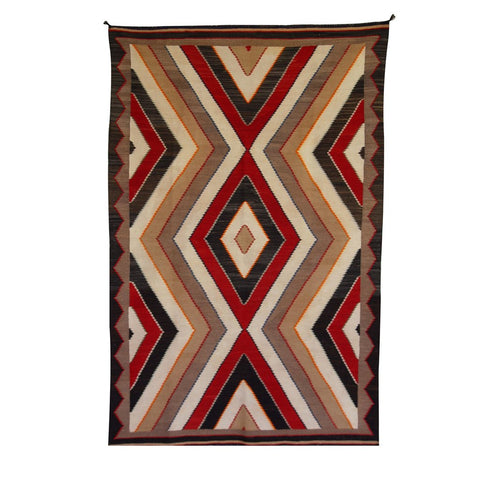
There are more similarities than differences when it comes to historic or vintage antique Navajo rugs, or contemporary newer Navajo rugs.

In fact, both maintain their authenticity because they use the same traditional weaving methods.

Contemporary Navajo Rug Master Weavers

A few examples of these Navajo weaving methods are:

  • Using sheep's wool. Many times handspun wool.
  • An upright loom with a continuous warp thread. A key differentiator.
  • Natural traditional dyes. Culturally authentic materials.

This is the same, exclusive Navajo weaving methodology used throughout history. (Click here for Historic Navajo Rugs..)

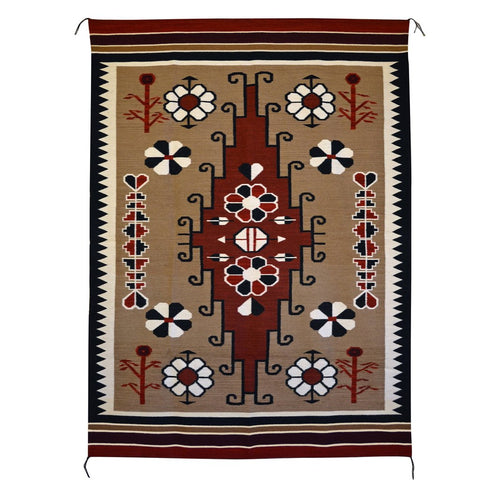
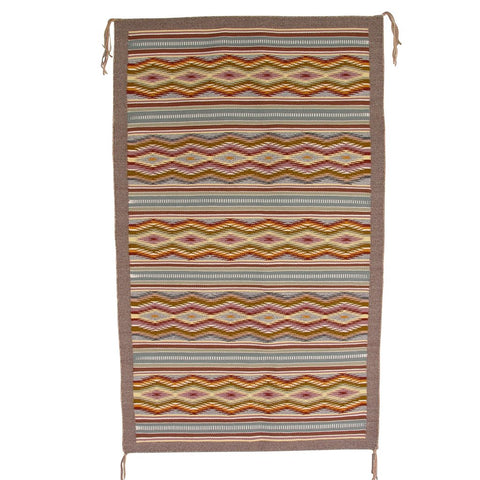
Thankfully, contemporary Navajo weaving is a true continuation of this beautiful historic art form. Contemporary Navajo weavers also combine historic styles and traditional designs with their own patterns, colors and flair.

And so continues the old WITH the new! The Next Phase.

Click here to skip to contemporary Navajo rugs for sale..

  • Beth Barth
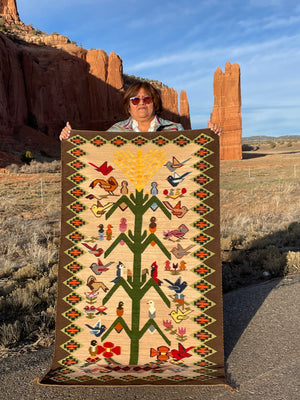
Tree of Life Explained

Tree of Life Explained

History of Tree of Life Rugs
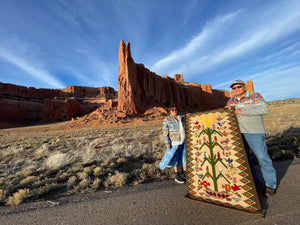
The Tree of Life Navajo Rug, often referred to as the Cosmic Tree.

Since their early days of the late 1800s, these weavings have often portrayed pictures of a wedding basket with a corn stalk springing forth, birds, and rainbow bars. These pictures are meant to represent progression and movement within life, as well as the connections between the Navajo, the Earth, and the Universe. 

Important Symbolism
Known for their remarkable beauty and iconic images, the fact remains that even today the Tree of Life rug design remains a meaningful symbol to the Navajo people. It’s so important, in fact, that they’ve even been the inspiration behind SandPaintings  and other artistic endeavors. A wonderful choice for celebrating the natural world and helping people reconnect and harmonize with nature, the Tree of Life is admired for its scenic designs and it’s fresh world perspective.  From the Navajo ceremonial perspective; the Blue birds are considered the messengers to the gods and rainbows represent life and all things good.


Pictorial Style
Weavers today still value what the Tree of Life rug represents and enjoy being able to share their creativity and imagination with bold colors, flourishing style and contemporary weaving. If you’re looking for a rug styling that’s not only breathtakingly gorgeous, but signifies an important tie between the Navajo and the world around them, then the Tree of Life rugs may just help you find your own connection with the world. 

  • Beth Barth
Foes of Evil: The Navajo Myth of Twins Monster Slayer and Born-For-Water

Foes of Evil: The Navajo Myth of Twins Monster Slayer and Born-For-Water

By: Aleksa Vuckovic, 8-10-2024

Foes of Evil: The Navajo Myth of Twins Monster Slayer and Born-For-Water

The Native American tribes boast a very complex and thought-provoking set of beliefs and traditions, in which the legend of heroic twin brothers is often shared and found in many tribes.
In the myths of the Navajo tribe, these twins are known as Monster Slayer and Born-For-Water, and are central figures in the tribe’s mythology, embodying themes of bravery, protection, and the struggle against evil. Their story is not just a tale of heroism but a complex set of cultural beliefs, values, and the enduring relationship between the Navajo people and their environment.

The tale of Monster Slayer and Born-For-Water begins with their mother, Changing Woman (Asdzą́ą́ Nádleehi), one of the most revered deities in Navajo mythology.  Changing Woman represents life, fertility, and transformation. According to the myths, she conceived the twins with the Sun, who gave her two pieces of turquoise and abalone shell, which transformed into the twins. The Changing Woman raised her sons on Gobernador Knob, a Navajo sacred mountain, where they learned about their divine heritage and the destiny that awaited them.

As they grew older, Monster Slayer and Born-For-Water became aware of the many monsters that plagued their people. These monsters were the personification of chaos and danger in the world. Determined to rid their land of these threats, the twins embarked on a perilous journey to the Sun's house to seek guidance and weapons. Their journey was fraught with challenges, including crossing a vast desert and overcoming numerous obstacles that tested their courage and resolve.

Warriors of the Sun

Each battle was not only a physical confrontation but also a spiritual one. The twins relied on their wit, bravery, and the teachings of their mother and father. They invoked prayers and rituals to ensure their success, highlighting the deep connection between their physical prowess and their spiritual strength.

We can quickly understand that the story of Monster Slayer and Born-For-Water is more than an epic adventure; it is a cornerstone of Navajo cultural identity. The twins symbolize the triumph of good over evil, the importance of bravery, and the necessity of working together for the greater good. Their tale is recounted in various ceremonies and rituals, serving as a reminder of the values that underpin Navajo society.

One of the most significant ceremonies associated with the twins is the Enemy Way (Anaaʼjí). This healing ceremony is performed to restore balance and harmony for individuals who have been in conflict or war. The stories of the twins are recited during the ceremony, emphasizing their role as protectors and healers. The twins’ journey and victories also serve as metaphors for overcoming personal and communal challenges.

In contemporary Navajo culture, the story of Monster Slayer and Born-For-Water continues to be a source of inspiration. Their legacy is preserved through oral traditions, storytelling, and art. Navajo artists often depict the twins in paintings, sculptures, and jewelry, each piece capturing the essence of their heroism and spiritual significance. What is more, their story resonates beyond the Navajo Nation, offering universal themes of courage, resilience, and the fight against adversity. Scholars and enthusiasts of Native American mythology study the twins’ tale to gain deeper insights into the rich cultural heritage of the Navajo people.

The Native American tribes boast a very complex and thought-provoking set of beliefs and traditions, in which the legend of heroic twin brothers is often shared and found in many tribes.
In the myths of the Navajo tribe, these twins are known as Monster Slayer and Born-For-Water, and are central figures in the tribe’s mythology, embodying themes of bravery, protection, and the struggle against evil. Their story is not just a tale of heroism but a complex set of cultural beliefs, values, and the enduring relationship between the Navajo people and their environment.

The Navajo Twins in Earliest Tribal Stories

The tale of Monster Slayer and Born-For-Water begins with their mother, Changing Woman (Asdzą́ą́ Nádleehi), one of the most revered deities in Navajo mythology. Changing Woman represents life, fertility, and transformation. According to the myths, she conceived the twins with the Sun, who gave her two pieces of turquoise and abalone shell, which transformed into the twins. The Changing Woman raised her sons on Gobernador Knob, a Navajo sacred mountain, where they learned about their divine heritage and the destiny that awaited them.

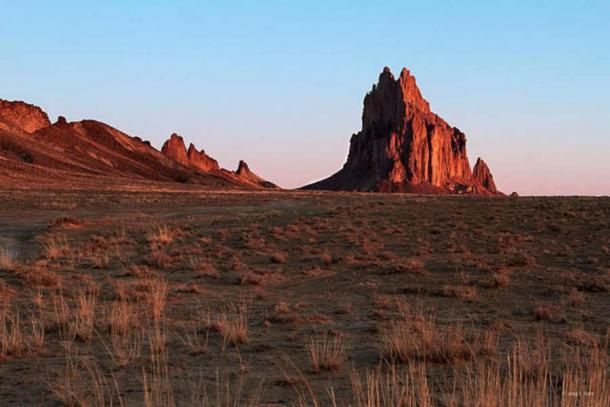
Traditional Dinétah territory (northwestern New Mexico), where Gobernador Knob (Chʼóolʼį́ʼí) is located. (U.S. Geological Survey/CC BY 2.0)

Traditional Dinétah territory (northwestern New Mexico), where Gobernador Knob (Chʼóolʼį́ʼí) is located. (U.S. Geological Survey/CC BY 2.0)


As they grew older, Monster Slayer and Born-For-Water became aware of the many monsters that plagued their people. These monsters were the personification of chaos and danger in the world. Determined to rid their land of these threats, the twins embarked on a perilous journey to the Sun's house to seek guidance and weapons. Their journey was fraught with challenges, including crossing a vast desert and overcoming numerous obstacles that tested their courage and resolve.

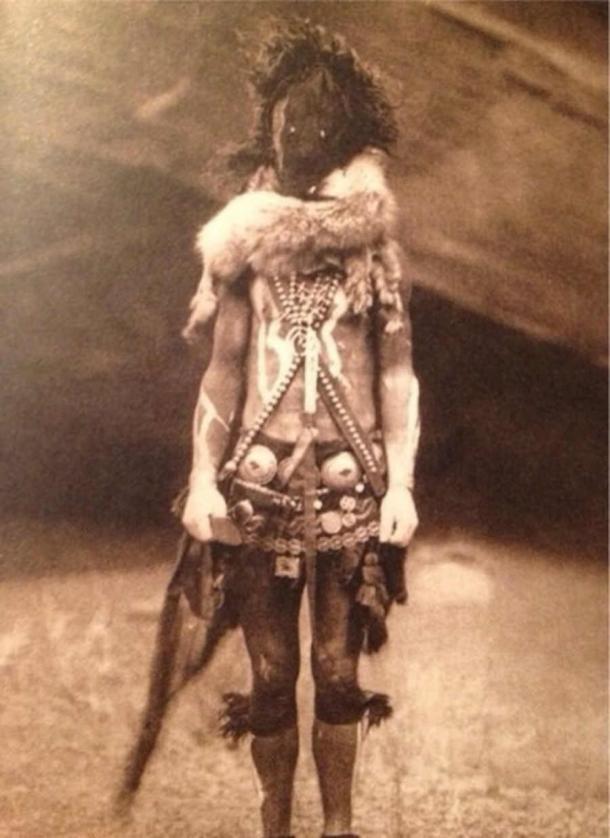
A Navajo man wearing a ceremonial mask and dress of Naayééʼ Neizghání, taken by Edward S. Curtis (c. 1904) (Public Domain)

A Navajo man wearing a ceremonial mask and dress of Naayééʼ Neizghání, taken by Edward S. Curtis (c. 1904) (Public Domain)

Upon reaching their father, the Sun, they underwent a series of trials to prove their worthiness. Impressed by their determination and bravery, the Sun bestowed upon Monster Slayer a magical bow and arrows, while Born-For-Water received a protective staff. These gifts were crucial for their mission to defeat the monsters. Armed with their new weapons, the twins returned to their homeland to confront the monsters. Monster Slayer took the lead in the battles, wielding his bow and arrows with deadly precision. His brother, Born-For-Water, played a supportive role, using his protective staff to aid and defend Monster Slayer. Together, they defeated numerous fearsome creatures, including the giants, the monsters at Shiprock (Tsé Bitʼaʼí in Navajo language), and the notorious Yeitso, the Big Giant.

Warriors of the Sun

Each battle was not only a physical confrontation but also a spiritual one. The twins relied on their wit, bravery, and the teachings of their mother and father. They invoked prayers and rituals to ensure their success, highlighting the deep connection between their physical prowess and their spiritual strength.

We can quickly understand that the story of Monster Slayer and Born-For-Water is more than an epic adventure; it is a cornerstone of Navajo cultural identity. The twins symbolize the triumph of good over evil, the importance of bravery, and the necessity of working together for the greater good. Their tale is recounted in various ceremonies and rituals, serving as a reminder of the values that underpin Navajo society.

One of the most significant ceremonies associated with the twins is the Enemy Way (Anaaʼjí). This healing ceremony is performed to restore balance and harmony for individuals who have been in conflict or war. The stories of the twins are recited during the ceremony, emphasizing their role as protectors and healers. The twins’ journey and victories also serve as metaphors for overcoming personal and communal challenges.

In contemporary Navajo culture, the story of Monster Slayer and Born-For-Water continues to be a source of inspiration. Their legacy is preserved through oral traditions, storytelling, and art. Navajo artists often depict the twins in paintings, sculptures, and jewelry, each piece capturing the essence of their heroism and spiritual significance. What is more, their story resonates beyond the Navajo Nation, offering universal themes of courage, resilience, and the fight against adversity. Scholars and enthusiasts of Native American mythology study the twins’ tale to gain deeper insights into the rich cultural heritage of the Navajo people.

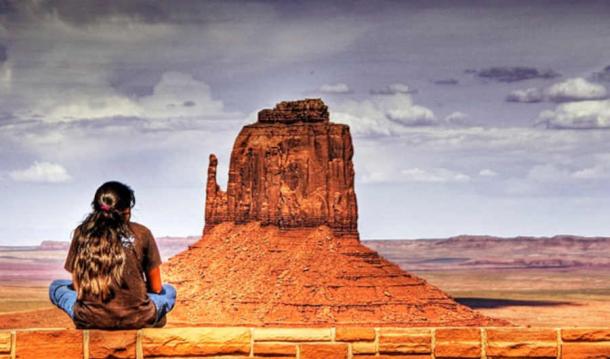
Navajo Girl, Navajo Reservation, Window Rock, Arizona. (Wolfgang Staudt from Saarbruecken/Germany, CC BY 2.0) 

Navajo Girl, Navajo Reservation, Window Rock, Arizona. (Wolfgang Staudt from Saarbruecken/Germany, CC BY 2.0)

The People of the Plains

The legend of Monster Slayer and Born-For-Water is a profound narrative that encapsulates the essence of Navajo mythology. From their divine birth to their heroic deeds, the twins embody the values and beliefs that have sustained the Navajo people for generations. Their story is a testament to the enduring power of myth and its ability to convey complex cultural truths and inspire future generations. Through the continued retelling and celebration of their adventures, the legacy of Monster Slayer and Born-For-Water remains a vital part of Navajo heritage, symbolizing the eternal struggle between good and evil and the unwavering spirit of a people that struggled so much in its history.


  • Beth Barth
Antiques Roadshow and Chief Blanket Phases

Antiques Roadshow and Chief Blanket Phases

BY Dennis Gaffney   |   POSTED 02.16.2007   |  UPDATED 01.25.2021

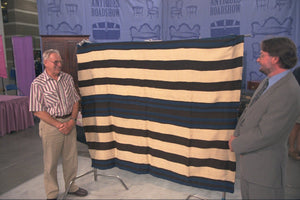
At the Tucson ANTIQUES ROADSHOW in summer 2006, appraiser Douglas Deihl, of Skinner in Boston, Massachusetts, examined an antique Navajo blanket, probably woven in the 1870s, that was colored with indigo blues and a variety of reds. "Stylistically," Douglas told the woman who owned the blanket, "this is called a Navajo third-phase chief's blanket." 

To unpack that phrase — "third-phase chief's blanket" — we contacted Tyrone Campbell, who has written books about Navajo weavings and is a dealer of antique Navajo and Pueblo weavings in Scottsdale, Arizona. Campbell explained the phrase and provided a cultural history of the Navajo blanket. Here's what we learned:

Evolutions in the style of chief's blankets through the 19th century

In the middle of the 17th century, the Navajo had begun sheep herding and making their own wool, skills they picked up from the Spanish settlers. By the late 17th century, they learned to weave from their neighbors, the Pueblo. The weaving skills of the Navajo craftswomen surpassed those of the Spanish and the Pueblo craftsmen within just a few decades, and Navajo blankets became a prized possession desired by the wealthier Indians and Spanish throughout the West.

"These were worn by the Navajos," Campbell says, "but they were also commercial items that were traded to the Sioux, the Cheyenne, and the Ute." They were prized, in part, because they served as coats by day and blankets by night and were far lighter than buffalo skins. The Navajo wove the blankets so tightly that they were "practically waterproof," notes Campbell.

The blankets were also valued for their beauty, and an important Indian would wear a blanket proudly as a ceremonial wrap on special occasions. They were commonly called "chief's blankets" by Indians and traders — and are still referred to by that name — because they were so expensive that only chiefs or other wealthy individuals could afford them.

To put it in perspective, Campbell says that in 1860, to buy such a blanket would have cost between $100 and $150. "Guys are making $5 a week if they're lucky, about half that if they're 'blue-collar,'" Campbell says. "So that's a year's wages for most men. You could buy a house for $200."

First Phase

Until about the 1820s, the Navajo made simple striped blankets identical to the Pueblo. Then Navajo weavers began making what cultural historians call the "first-phase chief's blankets." The design for these is the simplest of all the Navajo 19th-century blankets, consisting of brown, blue, and white bands and stripes. These blankets, which the Ute Indians prized (hence the reference to them as Ute-style) are most valued by Navajo blanket collectors today, in large part because of their rarity. Less than 50 of these first-phase blankets, made until roughly 1865, survive. In 2002, an unsuspecting owner of a first-phase Navajo blanket found out at the Tucson ANTIQUES ROADSHOW that his blanket was worth between $350,000 and $500,000.

Second and Third Phases

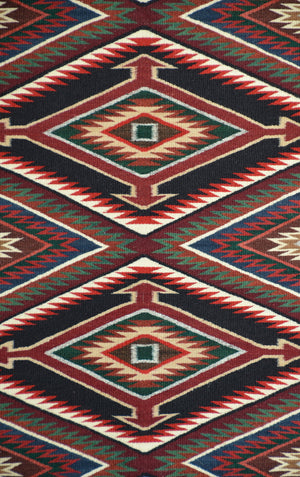
In about 1850, Navajo weavers began adding red rectangles to their blanket designs, which cultural historians use as a marker for "second-phase chief's blankets," which were made until about 1880. "They always have 12 rectangles, grouped in twos," Campbell says. "In the third phase, they went to nine diamonds and half-diamonds." As these design elements were added, they grew larger, becoming more centerpieces of the blankets than embellishments. During the third phase, Navajo weavers also added elements inside the diamonds, including, Campbell says, "zigzags, crosses, thin lines, stacked elements, and triangles."

At the beginning of the second phase, the weavers had also started expanding their color palette, adding yellow and green accents, for example. But one of the colors the Navajo weavers coveted most was the red from the prized bayeta cloth made in England and later, in Spain and Mexico. They would unravel the cloths and then weave the material into rectangles on their blankets. The bayeta, occasionally used in first-phase blankets, became a color and cloth that Navajo weavers used prominently in the second phase. The bayeta was dyed with cochineal, named after the cochineal beetle. "It came in rich shades from rose to deep burgundy and it's permanent," Campbell says. "There's no plant in the Southwest that will give you such an intense red that won't fade."

These three phases composed what is called the Classical period of Navajo blankets, which ended with the arrival of the railroad to the Southwest after 1880. "Cheap manufactured blankets arrived," Tyrone says. "If a Navajo blanket cost $100, one made by Pendleton" — a mill in Pendleton, Oregon, that manufactured blankets for Indians — "cost you $3. The market was killed," Campbell added. "In order to cater to the ever-greater number of tourists, the Navajo began making rugs."

A Fourth Phase?

In the summer of 2020, in anticipation of Deihl’s appraisal re-airing the following winter for a Vintage episode, the ROADSHOW team was researching the three phases of Navajo chief blankets and came across an article that spoke of something unfamiliar: a fourth phase blanket.

According to a 2013 article by Cannon Road Arts, a Santa Fe lifestyle and cultural center, “The fourth phase chiefs’ blankets, occurring generally after 1870 through the early 1900s, take the diamonds to an extreme with the background becoming much less important and the diamonds becoming the main focal element.”

This got the ROADSHOW team wondering, “Why do our appraisers only refer to first, second, and third phase chief's blankets during appraisals?" In August 2020, we reached out to longtime Tribal Arts appraisers Doug Deihl and John Buxton to clarify. Both experts agreed that the terms “fourth phase” and “third phase variant” are used synonymously, but “third phase variant” is more favored by most experts.

Buxton explained, “In my judgment, the term “third phase variant” or “fourth phase” are used somewhat interchangeably. Navajo classic first, second, and third phases were made as wearing blankets and not for sale to visitors from the East. As we get into the latter part of the 19th and beginning of the 20th century, we enter the transitional period where you see both wearing blankets and rugs made. By 1900, you begin to see the major impact of the trading posts located throughout the Navajo reservation, as commercialism is in full swing. You do see experimentation with designs, dyes, and techniques. The third phase was a very popular design that created interest for many different variations, hence the term “third phase variant.”

Deihl agreed, adding, “Very few people use the term 'fourth phase' to describe what is more commonly called a third phase variant blanket or rug.”

Watch:  Best Moment: Navajo Ute First Phase Blanket, ca. 1850 | Tearjerkers | ANTIQUES ROADSHOW | PBS

  • Beth Barth
History of the Tree Of Life

History of the Tree Of Life

History of Tree of Life Rugs
The Tree of Life Navajo Rug, often referred to as the Cosmic Tree.

Since their early days of the late 1800s, these weavings have often portrayed pictures of a wedding basket with a corn stalk springing forth, birds, and rainbow bars. These pictures are meant to represent progression and movement within life, as well as the connections between the Navajo, the Earth, and the Universe. 

Important Symbolism
Known for their remarkable beauty and iconic images, the fact remains that even today the Tree of Life rug design remains a meaningful symbol to the Navajo people. It’s so important, in fact, that they’ve even been the inspiration behind SandPaintings  and other artistic endeavors. A wonderful choice for celebrating the natural world and helping people reconnect and harmonize with nature, the Tree of Life is admired for its scenic designs and it’s fresh world perspective.  From the Navajo ceremonial perspective; the Blue birds are considered the messengers to the gods and rainbows represent life and all things good.


Pictorial Style
Weavers today still value what the Tree of Life rug represents and enjoy being able to share their creativity and imagination with bold colors, flourishing style and contemporary weaving. If you’re looking for a rug styling that’s not only breathtakingly gorgeous, but signifies an important tie between the Navajo and the world around them, then the Tree of Life rugs may just help you find your own connection with the world. 

  • Beth Barth
Churro Sheep History

Churro Sheep History

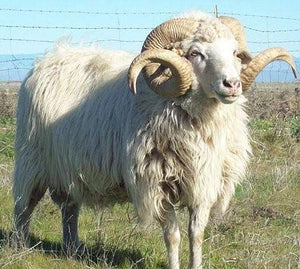
The Churro breed of sheep was introduced into the Rio Grande Valley by the Spaniards around 16th century and were obtained by the Navajos through raiding and trading.  The lustrous fibers of Churro Wool are long and straight with a very low lanolin content, making them ideal for the limited hand methods of Navajo weaving.  If you were to look at the Churro wool fiber under a microscope, it is actually translucent.  

For the Navajo weaver, historically one of the best parts of using Churro wool was less work to raise the sheep and prepare the wool.   The Churro Sheep are very hardy and well adapted to the harsh dry conditions under which the Navajo live and the low lanolin content means very clean wool (not a lot of water or time used to clean it).  The historic superiority of weavings produced from the wool of Churro sheep is very apparent in the blankets that have survived through time.  

The common Diné (Navajo) word for the breed, Dibé dits’ozí, means "long fleeced sheep." T’áá Dibé is also occasionally used, meaning "first sheep. The churro is important to Diné subsistence and culture.

History

The Spanish Churra (renamed Churro by American frontiersmen) was first imported to North America in 1598 by Juan de Oñate, conquistador who established the colony of New Mexico for Spain.  He used Churro Sheep to feed Spanish armies and settlers.  By the 17th century, Churros were popular with the Spanish settlers in the upper Rio Grande Valley.  The Churro soon became an important part of the Diné economy and culture.  The Navajo bred sheep to adapt to a pastoral lifestyle in a harsh desert environment.

During the Navajo Wars, American soldier Kit Carson instructed his troops to destroy Navajo crops and kill their livestock, including the Churro sheep, in 1863. They killed thousands of sheep. Some small clusters in remote canyons survived the attack. The entire Navajo nation was then forced to march to a reservation. The Navajo nation and the US government signed Treaty of Bosque Redondo in 1868, allowing the Navajo to return to their homeland. As part of the agreement, the US government provided sheep to the  Navajo; however, these breeds were unfamiliar and contaminated the Churro sheep line.

In the 1930s, the US government implemented the Navajo Livestock Reduction, intended to reduce the amount of sheep and horses on Diné lands. Tens of thousands of Churro sheep were slaughtered, and their numbers dwindled.  The Livestock Conservancy estimated that less than 450 Churros remained by the 1970s. This reduction of the flocks drove many Diné ranchers into poverty. Many Diné who had traditionally lived off of the land and agriculture turned to wage work.

Restoration of the breed began in the 1970s when breeders began acquiring Churro phenotypes with the purpose of preserving the breed and revitalizing Diné and Hispanic flocks. The Navajo Sheep Project, headed by Lyle McNeal, was the first organization to start a breeding program.

While the Navajo-Churro breed is no longer in danger of extinction, it is still considered a rare breed. There were over 8,000 head of Navajo-Churro sheep in 2022.

Cultural role

Diné weavers have used Churro wool to make rugs, wall hangings, and other products since the late 1600s.  The sheep naturally produce wool in fourteen colors, so weavers can produce complex colorwork without needing to dye the wool. The yarn produced from the wool is durable, coarse, and non-pilling.  Many Diné through the early 20th century made their livelihood in farming and ranching. Woven products, such as rugs and blankets, were and continue to be important exports.

Carding wool, spinning yarn, and weaving are traditionally women's work among the Diné. As such, flocks of sheep traditionally belonged to women and were passed from a mother to her children. Children learned to tend the sheep at a young age.

The specific Churro breed, as opposed to sheep in general, is an important part of Diné cultural identity. Elders in particular remembered the Churro flocks from the early 20th century. Some were overjoyed to see the revitalization from the 1970s onward:

I said, "Why are you crying for grandpa?" He said, "It's been a long time since I've seen these sheep. I'm so happy that they're here again."

Excerpted from an article printed in the June issue of Phoenix 2016 Home and Garden.

The Churro breed of sheep were introduced by the Spaniards in the mid 1500’s upon their discovery and colonization of the “New World”. Having originated in the mountainous regions of southern Spain, they were well adapted to the arid and poor forage conditions of this new environment. Twice on the brink of extinction, this hardy breed of sheep endures. In 1863, the Kit Carson/U.S. Military campaign to incarcerate the Navajo people and destroy their economy {the sheep} was successful in rounding up about half of the population, taking them to Bosque Redondo and killing a large percentage of their sheep. The escaping Navajo went into hiding with the remnants of their flocks. Upon returning from “The Long Walk”, they were issued new breeds of sheep, which for the most part replaced the Churro wool in their weaving. Some weaver’s preference for their “old wool” persisted, and many managed to rebuild their Churro flocks. Later, in the 1930’s, Congress enacted the Taylor Grazing Act; tens of thousands of sheep were killed. This federally enforced stock reduction program was the result of overgrazing and the severe drought conditions of the dust bowl era. Still a few bands of Churro survived, secreted away in the remote canyons of Navajo land.


Navajo weavers first used Churro wool during the classic period of Navajo weaving (1700-1863). The superior quality of these weavings is very evident in the blankets that have survived through time. The lustrous fibers of the wool were long and straight, ideal for the limited hand methods of Navajo weaving. Also, the low lanolin content reduced the necessity for extensive cleaning in a land of little water.


In recent years, the efforts of a few dedicated breeders have revived the Churro genetics and fleece quality. However, the circle was not complete, as the wool wasn’t getting into the hands of Navajo weavers. The most successful effort to reintroduce Churro wool to the Navajo loom was accomplished by native Arizonan, Steve Getzwiller. He set out to revive some of the older design elements as well as some rare and natural dyes. The reintroduction of Churro wool brought those lustrous qualities back to the finished weavings, completing the circle and reconnecting some of the weavers with their past. “The Navajo Churro Collection” was born.


  • Beth Barth
History of the Getzwiller Exclusive Navajo Churro Collection

History of the Getzwiller Exclusive Navajo Churro Collection

In the 1990s the quality and uniqueness of Navajo weavings was on the decline.  Steve met with an old friend, Ray Dewey, in Santa Fe and they discussed how the quality of Navajo weavings could be improved.  The answer was improve the quality of the wool and dyes.

For hundreds of years Churro sheep have been the center of Navajo life.  Navajo churro wool was the first weaving wool of the Navajo Nation because of its low lanolin content, long staple and translucent qualities.  Unfortunately the churro sheep were nearly exterminated by outside forces.  

In the Getzwiller Historic Textile (GHT) collection exists beautiful pieces that are 100 years old, woven with Churro wool.  Which confirms churro wool is the best and only becomes better with time.  This conclusion planted the seed with Steve to bring Navajo churro wool back to the loom.  

Steve was able to find the source of the Navajo Churro Registry where the genetics were being perfected for a better fleece.

Next, Steve found dye artists to dye the wool by hand for what would later be called the 'Navajo Churro Collection'.  Though it seems like a simple thing, this took several years to put together. The final step was finding the best weavers on the Nation who were willing to use the Churro wool. The weavers were thrilled with the wool and loved the new colors (Indigo, Cochineal and the highest quality dyes from Switzerland). With that, the Navajo Churro Collection was born.

The result of this project is history making in itself. For one thing the Navajo Churro Sheep are no longer on the endangered species list. Some of the very best master weavers of the Navajo nation are able to work on projects in the Navajo Churro Collection that they otherwise would not be able to do. They are given the very best wool which is hand dyed and custom spun ready for them to weave on their loom; the Nizhoni Ranch Gallery supports them through the weaving process even if it takes years for them to complete. A registry is kept of each weaving documenting the weaver, a photo of her, and the weaving. It is very important that in 100 years from now, the weavers will be recognized for their work.

The Navajo Churro Collection Weaving project is playing a part in preserving the Navajo weaving art in the Navajo culture. The Navajo Churro Collection celebrates the Navajo weavers and the art of the loom. The Nizhoni Ranch Gallery exclusively offers these weavings to the world, which represent some of the finest Navajo weavings ever made. Steve and Gail will continue their work and hope that one of the benefits of this project will be for young Navajos to take up this very difficult and beautiful art form, as it is a legacy well worth preserving.

Today “The Navajo Churro Collection” is a premier collection of contemporary Navajo Weavings, which are exclusively commissioned by Steve, from the Churro wool he provides to some of the most capable Navajo-weaving artists of today.  The fleece of this registered line of Churro sheep is of the highest quality available.  All of the wool is completely hand washed and custom spun.  The dyes utilized consist of natural vegetal dyes and the finest Swiss aniline dyes.  All colors are dyed by hand in small batches to achieve the highest grade of variegated reach hues.  The natural wool colors are also custom spun to create rich and variegated grays, browns, and tans.


Navajo Churro Master Weavers, (L to R) Elsie Bia, Gloria Hardy and Cara Yazzie
  • Beth Barth
2025 Gallup Inter-Tribal Indian Ceremonial Winners!

2025 Gallup Inter-Tribal Indian Ceremonial Winners!

We are so happy and proud of our weavers this year.  Eight out of ten weavers we entered won prizes!  Congratulations!

From our entries the weavers brought home:

The Steve Getzwiller Memorial Award

2 - Best of Category

6 - 1st Place Blue Ribbons

6 -  2nd Place Red Ribbons


Award Winners - 2025 Gallup Inter-Tribal Indian Ceremonial

Teec Nos Pos Navajo Rug: Cecelia Nez : Churro 1765 :
47" x 64" (3'11" x 5'4") : SOLD

Awards: 1st Place (145) and the Steve Getzwiller Memorial Award


Burntwater Navajo Rug : Elsie Bia : Churro 1779 :
50" x 72" (4'2" x 6')  : $ 9000 : SOLD
Awards : Best of Category and 1st Place (132)


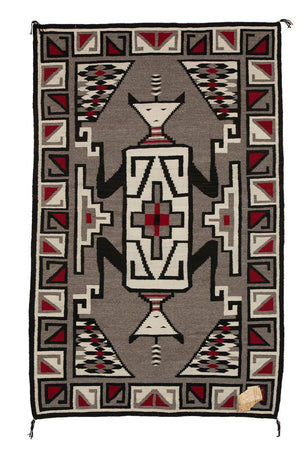
Three Turkey Ruin Navajo Rug : Helen Bia : Churro 1755 :
37" x 62" (3'1" x 5'2") : $ 8,000
Award : 2nd Place (122)


  • Beth Barth
The Schoch First Phase Chief’s Blanket - By John O'Hern

The Schoch First Phase Chief’s Blanket - By John O'Hern

The discovery of a Navajo masterpiece.

The weaving of wearing blankets is part of the Navajo (Diné) creation story, present in Navajo culture from the beginning. Spider Woman, who wove the web of the universe, taught the Navajo people to weave. She is present in their lives today, residing atop Spider Rock in Canyon de Chelly.


An Early Classic First Phase Chief’s Blanket, Diné (Navajo), circa 1830, also known as the Schoch First Phase. The first phase measures 54 inches long by 73 inches wide, as woven. In the collection of the Bernisches Historisches Museum (BHM), Bern, Switzerland, by purchase from Marie Karolina Ruef, Lorenz Alphons Schoch’s widow, 1890. BHM Catalog #1890.410.0027. Cataloged by BHM as a “Sioux trade cloth.” Photograph by Joshua Baer. © 2021 Joshua Baer & Company, Santa Fe. Used by permission. All reproduction rights reserved.

The Navajo philosophy of Sa’ah Naaghai Bik’eh Hozhoo guides life in balance and in harmony with the natural world and the universe. Balance occurs in the physical world with a reverence for the four cardinal directions, the four sacred colors and the four sacred mountains that border Navajo Country.

Balance is the theme of the Beauty Way Chant, part of which reads:

In beauty I walk
With beauty before me I walk
With beauty behind me I walk
With beauty above me I walk
With beauty around me I walk
It has become beauty again

To the south of Navajo Country, or Dinétah, were the Hopi. To the north were the Utes. Navajo wearing blankets were admired by the Hopi and Utes, who bartered with the Navajo for their blankets. Navajo blankets woven longer than wide were called “serapes” by the Spanish. Navajo blankets woven wider than long were called either “chief’s blankets” or “mantas.” The term “chief’s blanket” came into use because chief’s blankets were expensive. Only the high-ranking members of the Utes and the Plains tribes could afford them. According to Joshua Baer, an appraiser of Navajo blankets in Santa Fe, “Anglo-American explorers and military officers began collecting Navajo chief’s blankets during the 1840s. Between 1840 and 1860, the rate of exchange for one chief’s blanket was either 10 buffalo hides, 20 horses, or $50 in gold. In 1850, $10 was one month’s pay for a cavalry officer in the U.S. Army. The $10 gold piece, or ‘eagle,’ contained one-half of one ounce of gold.”

Karl Bodmer (1809-1893), Kiäsax, Piegan Blackfoot Man, 1833, watercolor and graphite on paper. Joslyn Art Museum, Omaha, Nebraska. Gift of the Enron Art Foundation, 1986.49.395. Photograph © Bruce M. White, 2019.

Navajo chief’s blankets were valued by the Ute, the Sioux and the Cheyenne because of their beauty, but also because they were so tightly woven as to be nearly waterproof and could be worn as a coat in the daytime and used as a blanket at night. Examples of early first phase chief’s blankets are scarce today because they were worn aggressively until they were worn out.

Early chief’s blankets featured broad stripes of blue, brown and white handspun Churro yarns. The handspun brown and white yarns were un-dyed. The handspun blue yarns were dyed in the yarn with indigo. Baer explains, “After the introduction of rectangular, target designs during the 1840s, and the subsequent introduction of concentric diamonds during the 1850s, Navajo chief’s blankets with no designs came to be known as ‘first phases.’ Chief’s blankets with rectangular designs came to be known as ‘second phases’ and chief’s blankets with concentric diamonds came to be known as ‘third phases.’” First-phase chief’s with broad brown and white stripes are referred to as man’s style, in contrast to the woman’s style chiefs blankets which have narrow stripes.

An Early Classic First Phase Chief’s Blanket, Diné (Navajo), circa 1830, also known as the Schoch First Phase. The first phase measures 54 inches long by 73 inches wide, as woven. In the collection of the Bernisches Historisches Museum (BHM), Bern, Switzerland, by purchase from Marie Karolina Ruef, Lorenz Alphons Schoch’s widow, 1890. BHM Catalog #1890.410.0027. Cataloged by BHM as a “Sioux trade cloth.” The image has been enhanced to show how the first phase may have looked in original condition.  Photograph by Joshua Baer. © 2021 Joshua Baer & Company, Santa Fe. Used by permission. All reproduction rights reserved.

First phase chief’s blankets with brown, white and blue stripes are known as Ute style first phase chief’s blankets. Blankets with thin red stripes between the blue and brown stripes are known as bayeta first phase chief’s blankets because of their use of raveled bayeta yarn. The Navajo weavers were adept at dying their handspun yarn blue with indigo but weren’t able to dye their handspun yarn red with cochineal. Produced in Mexico, cochineal is the dried and pulverized larvae of ladybugs. In the 17th century, cochineal was declared the property of the King of Spain and shipped to Spain where it was used to color woolen cloth in vats.

In response to Spain’s attempts to monopolize cochineal, the British developed a red dye from lac, a scale insect found in Bengal. Red bayeta cloth was woven and piece-dyed in Seville, Spain, and in Manchester, England, then exported in bolts to North America. Bayeta was then shipped from ports in New Orleans and Charleston to St. Louis where it was transported by mule to merchants in Santa Fe, Taos, and the Chama Valley. When bayeta arrived  in Navajo Country, Navajo weavers raveled the woven cloth to obtain red yarn to weave into their blankets. Between 1830 and 1860, bayeta was Navajo weavers’ primary source of red yarn. Navajo weavers also used a red knitting yarn from Germany, known as Saxony.

A Classic Bayeta First Phase Chief’s Blanket, Diné (Navajo), ca. 1850. The bayeta first phase measures 57 inches long by 71 inches wide, as woven. Collected, 1851, by Samuel W. Woodhouse (1821-1904), a surgeon and naturalist who accompanied the Topographical Engineer Corps on the Sitgreaves Expedition to explore the Zuni and Colorado Rivers. Inherited by Woodhouse’s son, Samuel W. Woodhouse Jr. (1873-1943). Purchased by the Museum of the American Indian (MAI) from Woodhouse Jr., 1923. Image courtesy of the National Museum of the American Indian (NMAI), Washington, D.C. NMAI Catalog #11/8280.

Baer explains the incorporation of red yarn in second and third phase blankets and subsequent variants: “Second phase chief’s blankets have horizontally banded fields with rectangular foreground designs, usually in the form of either concentric squares, concentric rectangles, or pairs of solid rectangular bars. Ute Style second phases have no thin red stripes between their design elements. Bayeta second phases have thin, horizontal red stripes of raveled bayeta between their design elements.

“Third phase chief’s blankets have horizontally banded fields with diamond-shaped foreground designs. Ute Style third phases have no thin red stripes between their diamonds. Bayeta third phases have thin red stripes of raveled bayeta between their diamonds.

“Navajo chief’s blankets that combine second and third phase designs are called variants. Chief’s blankets with designs appropriated from Navajo dress halves, mantas, poncho serapes or serapes are also called variants.”

An installation of the three phases of Navajo chief’s blankets can be seen at the National Museum of the American Indian in Washington, D.C. The Nelson-Atkins Museum in Kansas City, Missouri, has what Baer considers to be one of two Ute style first phase chief’s blankets in mint condition. The Nelson-Atkins also has as a chief’s blanket variant with a spur pattern in cochineal-dyed bayeta wool, circa 1840.

A Classic Second Phase Chief Blanket, Ute Style, Diné (Navajo), circa 1850. The second phase measures 56 inches long by 75 inches wide, as woven. Collected, 1851, by Samuel W. Woodhouse (1821-1904), a surgeon and naturalist who accompanied the Topographical Engineer Corps on the Sitgreaves Expedition to explore the Zuni and Colorado Rivers. Inherited by Woodhouse’s son, Samuel W. Woodhouse Jr. (1873-1943). Purchased by the Museum of the American Indian (MAI), New York, from Woodhouse Jr., 1923. Image courtesy of the National Museum of the American Indian (NMAI), Washington, D.C. Image courtesy of NMAI. NMAI Catalog #11/8281.

The Nelson-Atkins Museum describes its first phase blanket as “a broad horizontal configuration of contrasting and subtly colored bands…often described as a distillation of the Navajo’s desert plateau and mountain landscape.”

A characteristic of Navajo looms is that they were often set up outdoors where the weavers looked through them at the landscape as they worked.

The widespread trade in chief’s blankets is documented in a watercolor by Karl Bodmer (1809-1893), a young Swiss artist who accompanied the Prussian naturalist Prince Maximilian of Wied-Neuwied (1782-1867) on an expedition through the Missouri Valley from 1832 to 1834. Prince Max, as he was known, believed the Indigenous tribes of central North America were on the verge of extinction. He had set out to document their cultures before they disappeared.

Bodmer was a prodigy who would amaze audiences by creating an accurate sketch or watercolor in less than an hour. Prince Max would often use him to impress the people they met on their expedition. In 1833, on one leg of their journey, Bodmer painted Kiasax, a Piegan Blackfoot chief, wearing a Ute style first phase chief’s blanket with pairs of blue stripes. It is the earliest known painting of a Navajo chief’s blanket.

A Classic Third Phase Chief Blanket, Ute Style, Diné (Navajo), circa 1855. The third phase measures 58 inches long by 78 inches wide, as woven. Collected between 1855 and 1860 at Fort Laramie, Dakota Territory (now Wyoming), by Thomas S. Twiss (1802-1871), U.S. Indian Agent for the Upper Platte River). Acquired by Daisy M. Barnett (1874-1937), at an unknown date. Purchased by the Museum of the American Indian (MAI), New York, from Barnett, 1921, with funds donated by MAI Trustee Harmon W. Hendricks (1846-1928). Image courtesy of the National Museum of the American Indian (NMAI), Washington, D.C. NMAI Catalog No. 10/8457.

They met Kiasax aboard the steamer Assiniboine owned by John Jacob Astor’s American Fur Company. They also took advantage of Astor’s steamer Yellowstone, which they rode from St. Louis 900 miles north to Fort Pierre and Fort Union.

Prince Max’s choice of the scrupulously accurate Bodmer resulted in some of the finest paintings of the region and its people. The prince was as meticulous in his written descriptions as was Bodmer in his paintings and drawings. In a journal entry from March, 1833, he describes Massika, a Sauk man he met in St. Louis. “The area surrounding the eyes and ears is red, often also the cheeks; with others the entire head is completely red, except for a white spot on the forehead and a black one around mouth and chin; this gives them a dreadful appearance…Their ears are pierced along the upper edge with three or four holes, and from them hang short strings of blue and white wampum, like tassels.”

George Catlin (1796-1872), St. Louis from the River Below, 1832-1833, oil on canvas, 193/8 x 26¾”. Smithsonian American Art Museum. Gift of Mrs. Joseph Harrison Jr., 1985.66.311.

Prince Max’s collections were dispersed in museums in Bern, Berlin and Stuttgart.

George Catlin (1796-1872) traveled to the West five times in the 1830s, painting portraits of its Indigenous people and amassing artifacts from their cultures. He wrote in 1841, “St. Louis…is a flourishing town, of 15,000 inhabitants, and destined to be the great emporium of the West…[It] is the great depot of all the Fur Trading Companies to the Upper Missouri and Rocky Mountains, and their starting-place; and also for the Santa Fe, and other Trading Companies, who reach the Mexican borders overland, to trade for silver bullion, from the extensive mines of that rich country…I have also made it my starting-point, and place of deposit, to which I send from different quarters, my packages of paintings and Indian articles, minerals, fossils, etc., as I collect them in various regions, here to be stored till my return; and where on my last return, if I ever make it, I shall hustle them altogether, and remove them to the East.”

Lorenz Alphons Schoch traveled from Switzerland to St. Louis in 1832 and collected between 1833 and 1837, at the same time Prince Max and Bodmer were on their expedition and Catlin was collecting artifacts. Schoch was the son of a Swiss instrument manufacturer. Among the artifacts he collected is a war shirt that appears in George Catlin’s painting Mix-ke-móte-skin-na, Iron Horn, a Warrior, 1832.

George Catlin (1796-1872), Mix-ke-móte-skin-na, Iron Horn, a Warrior, 1832, oil on canvas, 29 x 24”. Smithsonian American Art Museum. Gift of Mrs. Joseph Harrison Jr. 1985.66.153.

Judy Thompson wrote The North American Indian Collection: A Catalog for the Berne Historical Museum in Switzerland. She comments, “Although European trade goods had reached the Plains area by the early 1700s, Plains Indians had little direct contact with white men until the mid-19th century. Collections as early as the Schoch material (1837) are therefore rare. Lorenz Alphons Schoch (1810-1866) was a Swiss from Burgdorf, Canton Berne. He went to the United States in 1832, where he lived in St. Louis for several years and apparently came into contact with various Indian tribes in his role of merchant or trader. Schoch returned to Switzerland in 1842. His collection was purchased from his widow in 1890.”


A Classic First Phase Chief’s Blanket, Ute Style, Diné (Navajo), ca. 1850. The first phase measures 51 inches long by 70 inches wide, as woven. In the collection of the Nelson-Atkins Museum of Art, Kansas City. Ex- Fred Harvey, Kansas City. Purchase: William Rockhill Nelson Trust, from the estate of Fred Harvey, 1933. NAMA Catalog #33-1430. Photo: Joshua Ferdinand.

Another item in the Schoch collection in Berne is a blanket cataloged by the museum as “Sioux Trade Cloth.” Baer believes it is the earliest documented example of a Navajo first phase chief’s blanket. It is illustrated here by his interpretation of the item if it is restored. He bases his hypothesis on five criteria:

  1. Its collection date (1832-1837) establishes the Schoch First Phase as the earliest Navajo chief’s blanket with a documented collection history.
  2. The absence of pairs of blue stripes in the Schoch First Phase makes it a unique example of the Navajo first phase style, and raises the possibility that the first phase was woven during the late 18th century, which would make it the earliest known example of a Navajo chief’s blanket woven in the man’s style.
  3. Ticking along all of the edges of its brown and white bands is unique to the Schoch first phase. Of the approximately 150 other known classic Navajo chief’s blankets, none have ticking along all edges of their horizontal bands.
  4. The Schoch First Phase’s configuration of three brown stripes and four white stripes above and below its central panel links the first phase to three of the best-known classic Navajo chief’s blankets in either museum or private collections. [The Twiss Third Phase Chief’s Blanket, Ute Style, Navajo, circa 1850, in the collection of National Museum of the American Indian, is illustrated here, on Page 43.]
  5. The location of the Schoch First Phase in the Bernisches Historisches Museum (BHM) in Bern, Switzerland, and BHM’s catalog listing of the first phase as a “Sioux Trade Cloth,” establish the Schoch First Phase as an undiscovered example of early classic Navajo weaving.
  6. A Classic Chief’s Blanket Variant, Ute Style, Diné (Navajo), ca. 1840. The variant measures 53 inches long by 72 inches wide, as woven. In the collection of the Nelson-Atkins Museum of Art, Kansas City. Purchase: William Rockhill Nelson Trust. NAMA Catalog #33-1432. Photo: Joshua Ferdinand.

Before Baer’s interpretation of what he refers to as the “Schoch First Phase,” the Navajo chief’s blankets with the earliest documented collection history were the classic bayeta first phase chief’s blanket, Navajo, circa 1850, also known as the Woodhouse Bayeta First Phase; and a classic second phase chief’s blanket, Navajo, circa 1850, also known as the Woodhouse Second Phase. Both were collected at Zuni Pueblo, New Mexico Territory in September, 1851, by Samuel Washington Woodhouse (1821-1904), who was a surgeon and ornithologist with the Sitgreaves Expeditions of 1849 and 1851. Both the Woodhouse First and Second Phase Chief’s Blankets exhibit no wear. They were probably purchased from their weavers. The blankets were acquired in 1923 by what is now the National Museum of the American Indian from Woodhouse’s son in 1923.

Baer remarks, “The Schoch First Phase is an extraordinary work of American art. The first phase is also an important part of American and Native American history. My hope is that the BHM will allow the Schoch First Phase to travel to the United States. This will make it possible for the first phase to be seen by contemporary Navajo weavers, and by the American public.”

  • Beth Barth
Whirling Log or Swastika?

Whirling Log or Swastika?

crystal antique rug with whirling logs

JB Moore Crystal with Whirling logs.  Circa 1910-1920

The Whirling Log or sometimes referred to as a "falling log" or "swirling log",  goes back thousands of years in human culture.  One of the oldest symbols made by humans, the Whirling Log dates back some 6,000 years.  Scholars generally agree it originated in India. 

In the Navajo culture the Whirling Log, represents part of their creation story, well being, good luck and protection.  The Whirling Log is often confused with the swastika due to their similar appearance.  The Whirling long is square and rotates where as the swastika is diamond shaped and angled symbol.


                  Navajo Whirling Log                                          Nazi swastika

The Whirling Log symbol in Navajo culture comes from the tale of the Whirling Log.

 The Whirling Log Tale - part of the Navajo creation story

Below is a simple rendition of the story.

The hero in the story is an outcast from his people.  He decides to leave and sets out on a long journey to seek peace and security.  At first the 4 Gods try to persuade him against going, but seeing his determination, they help him hollow out a log in which he travels down the river. 

Along the way he has many misadventures which ultimately result in his gaining important ceremonial knowledge. In one such instance he and his craft encounter a whirlpool, hence "whirling Log" and is captured by the Water People who carry him down beneath the water to the home of Water Monster. Black God threatens to set fire to Water Monster's home and the hero is released, but not before being taught by Frog how to cure the illnesses caused by the Water People.

When he finally reaches the lake that is his destination, the gods catch his log and help him to shore. Wandering about on land the hero comes upon a whirling cross with two Yeis (Holy People) seated on each end. From them he learns the knowledge of farming and is given seeds. He then returns home to his people to share these gifts.


Until the late 1800s, when J. Lorenzo Hubbell and J.B. Moore opened their trading posts in Arizona and New Mexico, Navajos portrayed the Whirling Log solely in their religious ceremonies in the form of sand paintings. But by 1896, with prodding by Hubbell and Moore, the symbol proliferated on Navajo rugs.  

In 1940, in response to Hitler's regime, the Navajo, Papago, Apache and Hopi people signed a whirling log proclamation. It read, "Because the above ornament, which has been a symbol of friendship among our forefathers for many centuries, has been desecrated recently by another nation of peoples, therefore it is resolved that henceforth from this date on and forever more our tribes renounce the use of the emblem commonly known today as the swastika . . . on our blankets, baskets, art objects, sand paintings and clothing." 

 Navajo whirling log proclamation


  • Beth Barth
Navajo Sandpainting Weavings

Navajo Sandpainting Weavings

The 'Navajo Sandpainting Weaving'
Preserves Tradition and Ceremony

Navajo Sandpainting Weavings

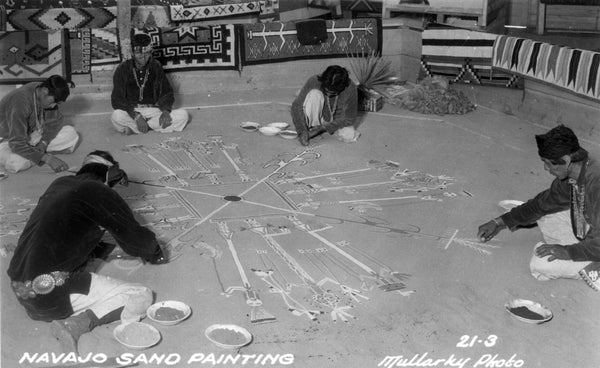
The Navajo Sandpainting Weaving is ranked among the Navajo tribe's best known and best loved art forms. The original Navajo dry painting is traditionally performed for religious or medicinal purposes; it is a sacred practice. Sandpaintings are used in ceremonies designed to summon supernatural forces, they represent the Navajo's religious world and are customarily part of ceremonies that will heal and restore a patient that is out of balance.

Example of a Navajo Sandpainting Weaving - a Yei / Yei Be Chei weaving

The Navajo Sandpainting Textiles: an artform that owes it's existence to weaver, artist, and Medicine Man,  Hosteen Klah (also spelled Hasteen, Hastiin).  From Native American Roots.net:  

In the 1880s, Klah began to learn weaving from his mother and from his sister. He first began to learn the Navajo medicine ways – chanting and sandpainting – from his uncle. In learning the Nightway ceremony, Klah worked under the guidance of Laughing Singer and Tall Chanter. While most Navajo singers can master only one or two complete chants, Klah mastered at least eight. Among the ceremonies which he mastered were the Hailway, the Mountainway, the Nightway, the Windway, and the Chiricahua.

Among the Navajo, the purpose of the chant is to cure the sick. For the chant to work, it must be repeated exactly by the singer. Learning a chant takes a considerable amount of intellectual work: each one is like memorizing hundreds of lines of song or poetry. When a singer contracts to perform a ceremony, he undertakes a great deal of responsibility for not only the patient, but also others who are present at the ceremony.  

In 1917, after 24 years of study, Hosteen Klah performed his first Nighway Ceremony (Yeibichai). The nine-day ceremony was perfect in chant, symbol, and ceremony and established him as a great singer.

In 1911 Hosteen Klah wove a blanket of yeibichai dancers which portrayed sacred masks. Local singers felt that this was sacrilegious and demanded that Klah have a ceremony to expel the evil and that he destroy the weaving. Instead, Klah sent the weaving to Washington and experienced no negative effects.

In 1917 Klah took Franc Newcomb, a trader’s wife, to a Nightway ceremony. After the ceremony, she attempted to draw from memory the designs from the sandpaintings which were used in the ceremony. She was unsuccessful and Klah sketched them for her in pencil. Newcomb then made these into watercolor reproductions and hung them in her bedroom so that the other Navajo would not be offended. After seeing that no punishment occurred, Klah then did an additional 27 paintings for her.

In 1919 Klah began to weave sandpainting rugs which were based on the chants he was qualified to sing. His first sandpainting weaving was a whirling log design from the Nightway ceremony.

Klah’s last sandpainting weaving, The Skies from the Shootingway ceremony, was done in 1937 and was not complete at the time of his death. The work was finished by his nieces, Gladys and Irene Manuelito.

Over the years, Klah worked with a number of non-Indian scholars and allowed them to record his songs, ceremonies, stories, and sandpaintings. His only Navajo student – Beaal Begay – died suddenly in 1931 and so much of his knowledge was not passed on in the traditional Navajo way.

One of the Anglos who worked with Klah was Mary Cabot Wheelwright (introduction through the Newcombs) who founded the Museum of Navajo Ceremonial Art in 1937.  She had been permitted to record many of Klah’s songs and erected the museum to preserve his medicine knowledge and his sacred objects.

The museum is now known as the Wheelwright Museum.  The Museum displays many of his drawings and paintings of sand paintings, as well as his sandpainting weavings. The Wheelwright is no longer actively involved in the study of Navajo religion, however it maintains growing, world-renowned collections that document Navajo art and culture from 1850 to the present. It also presents changing exhibitions on traditional and contemporary Navajo and other Native American arts.  

Hosteen Klah

Hastiin Klah with one of his sandpainting tapestries at the Newcomb’s trading post, Navajo, New Mexico, ca. 1927. 
Photograph probably by Arthur or Frances Newcomb. Hosteen Klah (Hastiin Tłʼa, 1867–1937)


Navajo Sandpainting Weavings on display at Nizhoni Ranch Gallery


  • Beth Barth