IMMER versandkostenfrei in den USA !!

Nizhoni Ranch News

RSS
The First Step In Navajo Weaving - Carding & Spinning Sheep's Wool

The First Step In Navajo Weaving - Carding & Spinning Sheep's Wool


Navajo weaving is both an art form and a labor of love. That’s because these highly-detailed rugs, blankets and weavings aren’t just for comfort; they tell an historic tale of a proud people through beauty and innovative creativity.

The origin of these well-woven textiles may have been passed down in story from Spider Woman who taught the first weavers to weave by using sunlight, white shells, lightning and crystals.

Here is more information about the historic methods of working with the wool after it is shorn from the sheep. 


Traditional Hand Carding
Historically, fleece and fibers were prepared before they could be used for weaving. Hand carding is the process of separating and straightening wool fibers using wooden paddles with wire “teeth” or bristles.

It works like this: the top “card” hooks its teeth into the wool in one direction, while the bottom “card” hooks its teeth in going the opposite direction. The weaver then works to gently tease and pull apart the wool creating evenly distributed layers, varying fiber lengths, eliminating any foreign matter inside, and improve fiber resiliency.

There are also two types of teeth which can be used—coarse and fine. The coarse cards are for fibers like mohair or wool, while the fine teeth can be used on soft fibers like cotton or angora.

 
Navajo Weaver Clara Sherman Carding and Spinning

Spinning the Perfect Thread

There are many forms in which to spin wool and the Navajo have a few techniques that can be used to form the perfect thread. The most famous and historic method is the Navajo spindle, also known as a drop spindle.

This type of spindle is generally categorized into three classes—center whorl, bottom whorl and top whorl. They all have varying degrees of speed and balance, but they can also produce different threat thickness.  These “hand spindles” involve spinning a stick with a weight top while the yarn twists and winds around the shaft.

Most of the historic weavings on our website are made with hand shorn, hand carded, hand spun Native Wool.  

  • Beth Barth
What is My Rug Worth?

What is My Rug Worth?


Here at Nizhoni Ranch Gallery we get our fair share of inquiries about Navajo rugs people have inherited from family members or picked up at a thrift show or estate sale.  Most stories begin with something like "my grandmother bought a weaving from a trading post while vacationing in the Southwest".

The main question we are asked is "what is it worth?"   The answer is:  it depends...  In valuing weavings we suggest keeping the following things at the forefront:

Size, Condition, Complexity of Design, Age, Tightness of weave, Types of dyes used (natural vs aniline) and provenance.

Size
Yes, size matters - a lot.  Big rugs are rare which of course increases value.  Past and present weavers typically weave small to medium size rugs.  One reason is limited space.  The larger the rug, the larger the loom.  Many Navajo live in homes that have low ceilings and low square footage, which makes it nearly impossible for many weavers to take on large rugs.  Another is the amount of time it takes to weave large rugs.  Large rugs can take a year or more to complete.  Weaver's payday typically come when they sell their rug.  Which means fewer weavers then and now take on large rugs.  

Navajo Weavers at loom


Condition 
The condition of a Navajo Rug will of course affect the value.  Pay attention to any damage,  if it is clean,  if there is any fading (one side is lighter than the other), if the wool colors have runs, stains, etc. There are talented rug restores out there, yet some issues just cannot be fixed.  Navajo rugs that have serious damage may not be worth the original cost or even the cost to restore it.  One rug restoration company we highly recommend is:  Enver From Denver. 
  
Age 
Early 1800's to 1950
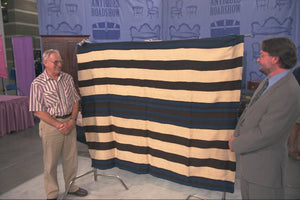
Navajo rugs before the 1950's we consider historic or antique.  Navajo weavings started to become popular at about the turn of the century. Navajo Textiles from 1800's have a much higher value - and they don't have to be in perfect condition.  Here is an episode from Antiques Roadshow.  Worth the watch and this weaving is worth up to 7 figures.  This episode brought us all to tears here at NRG.  

Astonishing Antique Roadshow Find - 1st Phase Ute Chief Blanket!
1940 to 1970 
In mid 1900 the Southwest was all the rage.  The Navajo keyed in on this and began weaving rugs for tourists.  A perfect and inexpensive souvenir that could easily fit in a suitcase to take home.  Navajo weavers would set up along side tourist routes.  Few tourists could resist a beautiful piece of art.  The weavings were small in size, designs were simple yet colorful, not always finely woven and not with the best wool.  These weavings typically have a moderate value.  Not necessarily a valuable family heirloom, but a warm reminder of who passed it down.


1970 to Present 
Today's Contemporary Navajo rugs, can range from UNDER $500 up to many thousands of dollars. The number of Navajo weavers working today is dwindling. Many Navajo are not learning this sacred Navajo weaving tradition, as it is a very time consuming, the pay is inconsistent and requires discipline in learning the art form.   Below is a weaving from our Exclusive Navajo Churro Collection that represents some of the best weavings of today.


Complexity/Tightness 
There are 28+ Styles of Navajo Rugs. Some Styles are more difficult to weave than others. Complexity and tightness of the weave affect the value. Generally speaking, the tighter and finer the weave, the more valuable the piece. Teec Nos Pos is generally considered one of the most intricate design.  
extra large Teec Nos Pos Navajo rug for sale
Navajo Churro Collection,  Teec Nos Pos,  Geraldine Phillips,  6"1" x 12'1", Churro wool, Circa 2015  Geraldine won Best of Category for large rugs in 2015.  Churro # 1574, $16,000


Natural Dyes vs Aniline 

Using natural dyes vs aniline dyes (commercial chemical dye).  Natural dyes add value because of the extra time it takes to hand dye the wool.  Hand dying wool with natural dyes can take almost as much time as weaving the rug.  See a previous blog we wrote on natural dyes:  An Organic Experience


Provenance 

Provenance is the history and ownership of the weaving.  When the history of a weaving can be verified it takes on a whole new value.  Again we go back to the Antique Road Show Episode with the well known Ute Chiefs blanket.  The provenance (proof) went all the way back to Kit Carson.  

 First Phase Ute Blanket, circa 1850,  PBS Antique Roadshow 

The Bottom Line 
If you want to get an accurate value on a weaving,  contact a certified appraiser that specializes in Native American art, or better yet Navajo weavings.  Nizhoni Ranch does not do appraisals, as we are not certified appraisers.  We suggest contacting Joan Caballero Appraisals in New Mexico : website   http://www.collectorsguide.com/jcaballero.


  • Beth Barth
Don't Fall for a Knock Off Navajo Rug!

Don't Fall for a Knock Off Navajo Rug!

2,575 Surprised Older Stock Photos - Free & Royalty-Free Stock Photos from  Dreamstime - Page 6

Oh, the thrill of stumbling across a beautiful weaving at a spectacular price.  Here at Nizhoni Ranch some of our clients have interesting stories about coming across an estate sale, consignment shop, garage sale or auction house where they hit the jackpot or crapped out.

Yet, the old adage "if something sounds to good to be true, it probably is".  Probably is the downfall for some.  The definition of probably is: without much doubt, reasonably true, likely.  Probably is trouble - it gives a ray of hope to those who want to believe.

Then there is the Antique Roadshow situation.  As AR passed through Tucson in 2001 a man took in a blanket he inherited from his grandmother. The blanket was originally given to his great grandfather by Kit Carson. The blanket was used on his bed as a child then later sat on the back of a chair for years.  After watching the appraiser almost pass out and then being whisked away by security, he was told the weaving was a Ute First Phase Blanket, circa 1850's.  A national treasure worth (at that time) $350k to $500k.  Today that very weaving is valued somewhere around 1+ million.  A beautiful story that remains one of AR's finest moments - a must see and a tear jerker!

So what is one to do?  Pay close attention to:

1 - Fringe

Almost all Navajo weavings will not have fringe.  There are only 2 exceptions. Textiles woven with Germantown yarn.  Fringe is added after the weaving is completed.  Take a look:

Saddle Blanket - Single Sunday Navajo Weaving : Historic : PC 119 - Getzwiller's Nizhoni Ranch Gallery

Germantown Saddle Blanket, PC 119


The other Navajo weaving that has fringe (only on one end) is a Gallup Throw.  Gallup throws became a popular and inexpensive tourist souvenirs.  They are woven with a cotton warp.  Once finished the warp is cut then knotted. A typical contemporary Gallup Throw sells for somewhere between $50 to $100.  See below:

Ganado Throw


 2. Warp

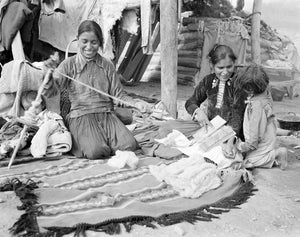
Warp strings run vertically and made on a continuous loom that contains the actual warp threads, this is the foundation of any Navajo weaving. You can check this by running your hand along the side of the rug to feel whether the warp threads run the length of the rug or whether they’ve been cut. In Mexican-made copies, the warp strings run horizontally and threads are cut and then sometimes hidden, making it more difficult to detect.  

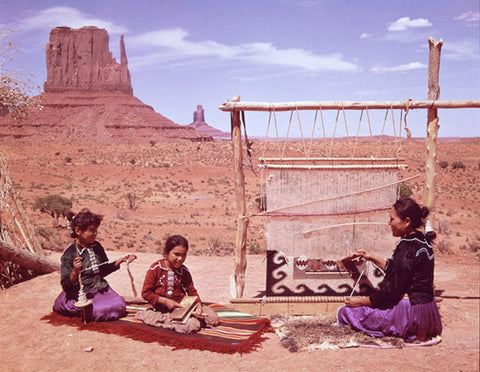
Mother and children Navajo weaving rug

 Navajo woman weaving on an upright loom with vertical warp strings.


3. Lazy Lines

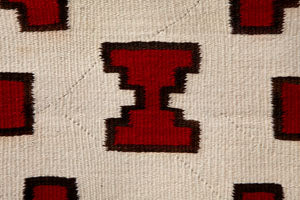
Lazy lines appear as a diagonal line in the weave of the fabric. During the weaving process, the rug maker would move to work on adjacent sections of the warp, resulting in the subtle diagonal lines referred to as lazy lines. Note: not every Navajo weaving has visible lazy lines.

Lazy lines in Navajo weaving

 Lazy lines at diagonal angles


 4. Cost

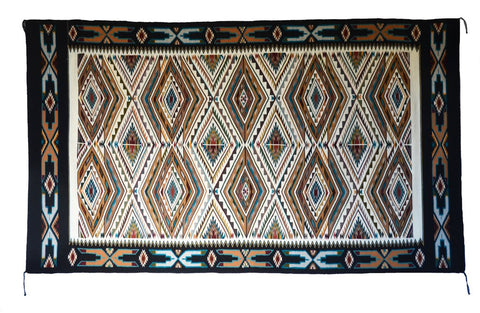
Like all Navajo weavings, the values vary based on the age, quality, size, design complexity and condition.  A 3 x 5 contemporary weaving, with good design, good condition and nice wool starts around $ 2,000.  Below is a contemporary Teec Nos Pos / Red Mesa weaving.  Teec Nos Pos is one of the most intricate of designs. This was woven in 2017 by Elsie Begay and measures approximately 5' x 9', $9,000.

Red Mesa Teec Nos Pos Nizhoni Ranch GAllery

The U.S. Department of the Interior, Indian Arts and Crafts Board have published a very informative pamphlet on How to Buy Authentic Navajo (Dine') Weavings.  Call 888-278-3253

Bottom line, buy through a reputable source and keep all receipts and other documents.  Reputable, meaning they stand behind the weaving and if it's not as portrayed, they will return 100% of what you paid.  

If you are fortunate enough to have a weaving pop up outside of a gallery or reputable dealer and told it is Navajo, buyer beware.  We believe if you love a weaving, the price is right and will still be happy if the weavings turns out to be something other than Navajo - go for it!     

Happy Hunting!


  • Beth Barth
Navajo Land and People

Navajo Land and People

Navajo Land and People


navajo people
A storied culture that began more than 500 years ago, the Navajo people got their name from the phrase Teva Navahu; which means “highly-cultivated lands.” This designation seems rather apt, especially given that we now know that they are widely considered the largest of all Native American Indian tribes in the world.

More hunters and gatherers than raiding warriors, the Navajo culture really began to flourish in the four corners area of the Colorado Plateau. It was here that they were first contacted by the Spanish, who drove them off their lands and further into New Mexico and Arizona.

By the middle of the 1800s, many of the Navajo were captured during the Scorched Earth Campaign and forced to walk more than 350 miles east to Fort Sumner; those who lived were hardened by the journey and years of war.

navajo people

Later that same century the Navajo, the only indigenous people allowed to return to their home land, were released to return to their reservation.  They found solace in their surroundings, raising their sheep and creating gorgeous textiles that gave them a prosperous edge in the changing financial times.

In 1906, John and Louisa Wetherill, ranchers and traders by nature, started at trading post which gave the Navajo people an outlet to trade their goods with those heading west to seek their fortune. And over the next 20 years, those trading posts expanded giving them even more opportunity to share their beautiful wares and textiles with people all over the country.

In the last decade, the rich history of the Navajo has steadily (and thankfully) been passed down from generation to generation. Families remain strong and close; the heritage can still be found in the language, the people, and their craftsmanship; and old traditions and pride still permeate the very fiber of their unique society.

And whether it be the exclusive textiles created with each generation, the world-changing code talkers of World War II, or the beautiful culture that impacted the very essence of society, the Navajo have long been a driving force behind what it means to be a Native American.   


Navajo Indians: Matriarchal Society

Navajo society
The Navajos are matriarchal and descent is traced through the mother.  While the basic unit of social cooperation is the biological family, the term “family” is considerably broader in it’s application to Navajo society than it is in the white American world.  A biological family, historically, lived in a cluster of hogans and nearby, usually within shouting distance, lived the “extended family.”  An extended family would consist of an older woman, her husband and unmarried children, and her married daughters together with their husbands and unmarried children.


An extended family might also consist of unmarried, widowed or other relatives of the older woman of the household.  Historically an extended family lived together in a designated vicinity and changed the place of residence as a group as the weather or foliage for the livestock dictated.  Within the extended family labor is pooled to a great extent in herding and other productive activities.  A man living with his wife’s family may also participate in the work activities of his own extended family. 


He often visits the homes of his mother and sisters and lends a helping hand in harvesting and other group activities.  A man will sometimes pasture his livestock with that of his mother or sister rather than with the property of his wife and children.

Until recently there was no conception of joint property ownership between husband and wife.  As a result Navajo women have always enjoyed a favored and somewhat more “liberated” position in their society than have their white counterparts.  A woman controls the hogan, built on land that was set aside for her by her family; she owns the children, which belong to her clan, her sheep, the product of her sheep and other livestock, her jewelry and all blankets she might weave and the income from the sale of any of her property.  A husband owns what he has inherited from his own family and all goods which he has bought out of his own earnings which, nowadays, often includes a pick-up truck.  Either partner may sell or trade what he owns, though one usually consults with the other about any major transactions.    …………. Raymond Friday Locke 


THE NAVAJO INDIAN HOGAN: Shelter and Center of their World

navajo hogonBeautiful Rainbow of the Navajo.  At the center of the Navajo world is their shelter, the “HOGAN”.  Navajos do not refer to their mode of living as a way of life…   It is THE way of life …         

The ancient hogan, known as the “forked stick hogan” was a conical hut constructed of three forked poles covered with logs, brush and mud.  Called the ” mail” hogan by the Navajos, examples of this swelling can still occasionally be found in the western part of the reservation.  More common today is the “female” hogan, a circular or 6 sided dwelling constructed of logs or stone, (below) with a doorway facing east and a smoke hole in the center of the roof.

The dome-shaped roof is formed of cribbed logs covered with dirt. (top photo) The fire  is placed on the hard-packed floor beneath the smoke hole and a flap or hinged door covers the doorway.  Traditionally the hogan lacked windows and was ventilated by the smoke hole in the roof and the east-facing doorway.  Nowadays not only do the hogans have windows but they may also contain stoves, chimneys, beds and even a refrigerator and a T.V.

Navajo Hogon
Today white prototype houses and even mobile homes are common on the reservation, but families that live in such dwellings also construct a hogan nearby.  Many of the People have retained their native religion and Navajo ceremonies can be conducted only in a hogan.

Most Navajo families own 2,3, or several hogans and more than one permanent establishment if they own sheep.  A family that owns several hundred sheep and other livestock might have as many as 5 or 6 separate clusters of buildings scattered over a large ara as the animals must be moved from place to place at various seasons of the year.  Too,variations in the weather and the water supply may require that a family live in one place during the summer and another during the winter.  Usually however, each family has one location which is its main residence at which there are more or less permanent corrals, storage dugouts, several hogans and temporary shades or bush hogans for summer use.

Navajo Hogon
The Navajo hogan is more than just a place to eat and sleep and the concept of it as a “home” bears little resemblance to a white person’s attitude toward his dwelling place.  The hogan is a gift of the gods and as such it occupies a place in the sacred world.  The first hogans were built by the Holy People of turquoise, white shell, jet, and abalone shell.  The round hogan is symbolic of the sun and its door faces east so that the first thing that a Navajo family sees in the morning is the rising sun…. Father Sun, one of the most revered of the Navajo deities.  The construction of a new hogan is almost always a community affair.  Once completed, the new hogan is consecrated with a Blessing Way rite whereby the Holy People are asked to “let this place be happy.”

Navajo Hogon
Also nearby, but out of sight, will be at least one sweat hogan.  The sweat hogan is small scale replica of the old-style forked stick hogan but without the smoke hole.  It is constructed of three sticks with forked ends which are fasten together in a tripod.  Two straight sticks are leaned against the apes from the east to make the sides of the door.  It is heated by placing hot rocks within, the door being closed with several blankets.  
The sweat hogan provides excellent bathing and purifying facilities for the Navajos in their land of scarce water.  As in virtually everything a Navajo does, there are prescribed rituals that must be followed in taking a sweat bath.  Four verses of the Sweat Bath Song must be sung before a Navajo can leave the sweat hogan, which the Navajo call the Son of the She Dark, to plunge into cold water or dry himself in the sand.  The bather then re-enters the sweat hogan and sings four more verses of the song.  He repeats the ritual until the entire song has been sung. 

navajo hogan
Traditional structured hogans are also considered pioneers of energy efficient homes. Using packed mud against the entire wood structure, the home was kept cool by natural air ventilation and water sprinkled on the dirt ground inside. During the winter, the fireplace kept the inside warm for a long period of time and well into the night.    …………. Raymond Friday Locke 


Athapascan Ancestors

navajo land and people|
First there was a beautiful and rugged land. And then came the people to the land and they called themselves Dineh. But they, the descendants of those Athapascan-speaking people would come to be known by many names. Dineh (or Dine), their name for themselves, cannot be translated exactly into English as there are no articles in the Navajo Language. The translation, “The People,” is formally permissible and accepted by most linguists and anthropologists, but Dinehcan also be translated as “men,” or “people” or even “earth people.”

According to Navajo tradition their ancestors, after many generations of wandering through inhospitable lands, came together and settled in a new land in this, the fifth world of their mythology.  This land was called Dinehtah- the land of The People.

Today over 170,000 Navajos live on their reservation which encompasses about 27,000 square miles of rugged, semi arid land in the states of Arizona, New Mexico and Utah.  The Reservation, which is about the size of the state of West Virginia.

Navajo Song:

“This is your home, my grandchild!” 
“My grandchild! I have returned with you to your home,
“Upon the pollen figure I have returned to sit with you, my grandchild!”  
He says to me as he sits down beside me;

“Your homes are yours again – Your fire is yous again – Your food is yours again – Your mountains are yours again, my Grandchild,”
He waves to me as he sits down beside me.    Navajo Song

…………. Raymond Friday Locke  


“Dine – The People”

~With beauty before me, it is woven
~With beauty behind me, it is woven
~With beauty above me, it is woven
~With beauty below me, it is woven
~And in beauty, it is finished.
Navajo weavers’ song……….. 

  • Beth Barth
History of Navajo Weaving

History of Navajo Weaving


Historic Navajo Rug

There are many tales and stories regarding the rich Navajo history in America. None may be more intriguing and exciting than that of Spider Woman. A deity that holds a special place in the Navajo culture, it is believed that she is the one that taught the Navajo to weave.

It's said that the first loom was made from sky and earth cords, and that the weave itself was made from sunlight, lightning, crystals and white shells.  For more tales about Spider Woman, Read "Spider Rock, Home of Spider Woman".

However, anthropologists believe is was the Pueblo people who taught the Navajo how to create Native American hand-woven blankets and that Navajo artists were influenced in part by the Spanish who had introduced cotton to the Pueblo long before 1650.

Initially, the Pueblo men would weave the textiles; but the Navajo, being a matriarchal society in which the women owned the sheep and were the ones to weave with the wool.

Historic Navajo Rug

What began with weaving women's dresses (two identical blankets sewn together), eventually became single blankets (mantas), then Chief's blankets, and evolved on to different styles and designs of blankets and rugs.

Over time, the Navajo Indian rug scene became more beautiful, diverse and sought after with each passing year. Yarn's changed, from natural hand-carded, hand-spun, and hand-dyed yarns, to Germantown yarns, to native wool spun in small mills, to some of the prized Navajo Churro wool pieces of today.

Spider Woman's teachings can still be found in modern-day craftsmanship, as the Navajo weaving is done the same way it now as was on the first Navajo loom: using a hand-made upright loom, with one continuous warp, and each stand of woolen yarn is placed into the warp, by hand, one strand at a time. That is why if a Navajo rug is cut of compromised in anyway – it will not unravel. This is a process that cannot be mechanized – making the Navajo weaving one of the most unique in the world.

From the very first "Black Design Blanket" Spider Woman created; to the gorgeous Two Grey Hills or historic Storm Patterns weavers craft today, each textile has one thing in common; they are carefully and spiritually created by expert hands who understand the value of earth and the gifts it gives us. Navajo weaving is a transformation of what mother nature offers to us to give life, the Navajo have used this gift to live off of the land and prosper for hundreds of years.


  • Beth Barth
No More Wall Space?  No Problem!

No More Wall Space? No Problem!

Our wonderful clients from San Antonio sent this to us:

"Finding the right place for our collection of Navajo rugs, blankets and serapes that we have purchased from your gallery over the years is not easy. I made this bench seat of cherry wood that finally works. It is 7’ wide and 30” high. I thought you would enjoy seeing how great it works as well. Do you recognize them? Many years of enjoyment".

Yes, we recognize ALL of them. What a wonderful way to display.  We will mention to collectors who complain they have run out of wall space - that they might need a bench! 

  • Beth Barth
How Much is My Rug Worth????

How Much is My Rug Worth????

Here at Nizhoni Ranch Gallery we get our fair share of inquiries about Navajo rugs people have inherited from family members.  Most stories begin with something like "my grandmother bought a weaving from a trading post while vacationing in the Southwest"

The main question we are asked is "what is it worth?"   The answer is:  it depends...  In valuing weavings we suggest keeping the following things at the forefront:

Size, Condition, Complexity of Design, Age, Tightness of weave, Types of dyes used (natural vs aniline) and provenance.

Size
Yes, size matters - a lot.  Big rugs are rare which of course increases value.  Past and present weavers typically weave small to medium size rugs.  One reason is limited space.  The larger the rug, the larger the loom.  Many Navajo live in homes that have low ceilings and low square footage, which makes it nearly impossible for many weavers to take on large rugs.  Another is the amount of time it takes to weave large rugs.  Large rugs can take a year or more to complete.  Weaver's payday typically come when they sell their rug.  Which means fewer weavers then and now take on large rugs.  

Navajo Weavers at loom


Condition
The condition of a Navajo Rug will of course affect the value.  Pay attention to any damage,  if it is clean,  edges are damages,  if there is any fading (one side is lighter than the other), if the wool colors have run, stains, etc. There are talented rug restores out there, yet some issues just cannot be fixed.  Navajo rugs that have serious damage may not not even be worth the original cost.  One rug restoration company we recommend our customers to is:  Enver From Denver. 
 
Age
1840 to 1950
Navajo rugs before the 1950's we consider historic or antique.  Navajo weavings started to become popular at about the turn of the century. Navajo Textiles from 1800's have a much higher value - and they don't have to be in perfect condition!  


1940 to 1970
In mid 1900 the Southwest was all the rage.  The Navajo keyed in on this and began weaving rugs for tourists.  A perfect and inexpensive souvenir that could easily fit in a suitcase to take home.  Navajo weavers would set up along side tourist routes.  Few tourists could resist a beautiful piece of art.  The weavings were small in size, designs were simple yet colorful, not always finely woven and not with the best wool.  These weavings typically have a moderate value.  Not necessarily a valuable family heirloom, but a warm reminder of who passed it down.


1970 to Present
Today's Contemporary Navajo rugs, can range from under $750 up to many thousands of dollars. The number of Navajo weavers working today is dwindling. Many Navajo are not learning this sacred Navajo weaving tradition, as it is a very time consuming, the pay is inconsistent and requires discipline in learning the art form.   


Complexity/Tightness
There are 28+ Styles of Navajo Rugs. Some Styles are more difficult to weave than others. Complexity and tightness of the weave affect the value. Generally speaking, the tighter and finer the weave, the more valuable the piece. Teec Nos Pos is generally considered the most intricate design.  
extra large Teec Nos Pos Navajo rug for sale
Navajo Churro Collection,  Teec Nos Pos,  Geraldine Phillips,  6"1" x 12'1", Churro wool, 2015  Geraldine won Best of Category for large rugs in 2015.  Churro # 1574, $18,000, 
 
Natural Dyes vs Aniline
Using natural dyes vs aniline dyes (commercial chemical dye).  Natural dyes add value because of the extra time it takes to hand dye the wool.  Hand dying wool with natural dyes can take almost as much time as weaving the rug.  See a previous blog we wrote on natural dyes:  An Organic Experience

Provenance
Provenance is the history of the weaver and ownership of the weaving.  When the history of a weaving can be verified it takes on a whole new value.  The well known story of the PBS Antique Roadshow Ute blanket's provenance went all the way back to Kit Carson.  A must see video from Antique Road Show - warning it is a tear jerker!

 First Phase Ute Blanket, circa 1850,  PBS Antique Roadshow

The Bottom Line
If you want to get an accurate value on a weaving,  contact a certified appraiser that specializes in Native American art, or better yet Navajo weavings.  Nizhoni Ranch does not do appraisals, as we are not certified appraisers.  We suggest contacting Joan Caballero Appraisals in Amarillo/New Mexico : website   http://www.collectorsguide.com/jcaballero.


Happy Trails,

Gail and Beth

Nizhoni Ranch Gallery
P.O. Box 815
Sonoita AZ 85637
Phone: 520-455- 5020 
Email: nizhoniranch@gmail.com

  • Beth Barth
Legendary Trader - Bill Malone

Legendary Trader - Bill Malone

Bill Malone
1939-2025 

By, Friends of Hubbell

A Founding Father of Friends of Hubbell and One of the Last Authentic Indian Traders

Billy Malone, a Founding Father of the Friends of Hubbell Organization and legendary trader to the Navajos, walked on from this earth on May 10, 2025.  For nearly 65 years, Billy served and traded with the Southwest Native American community, both on the Navajo and Hopi Reservations.

Fresh out of the U.S. Army and unable to find employment, he began his colorful career in the early 1960s working at the trading post in Lupton, Arizona.  While working at Lupton, Billy met and married Minnie Goodluck, with whom they would spend more that 60 years together.  After working in Lupton about a year, he ventured to Keams Canyon, Arizona, on the Hopi Reservation, and began working under the tutelage of Cliff McGee, a well-known and respected operator of trading posts on the Hopi and Navajo Reservations. Billy caught the “bug” of becoming a full-time Indian Trader.

He was a ‘natural’ for the job and soon was moved to become assistant manager at the Piñon, Arizona, Trading Post on the Navajo Nation. Billy and Minnie spent 19 years at Piñon, started their family, and became an essential part of the community. While at the Piñon trading post, Billy, who became fluent in the Navajo language, became the trusted trader and partner to the surrounding Navajo community; making their phone calls, writing letters, officiating at funerals, settling disputes, and everything else that goes along the life of a trader. He also served as banker – cashing checks, making loans till payday, trading for store goods and supplies on credit, buying and selling livestock and wool, and trading for rugs, jewelry, saddles, and anything else the Diné brought in for trade, cash or collateral. Back in those days, the Navajo considered jewelry as a valuable trade commodity and Billy was not prone to “killing” (selling) their pawned items if someone was behind on payments. He realized it was very often family heirlooms and would work with the borrowers for as long as it took. For her part, Minnie, in addition to raising their family, became an accomplished weaver and silversmith, and later became the first Navajo Postmaster at Piñon, Arizona – a first for the Navajo Nation.

In 1981, Billy and Minnie moved from Piñon to Ganado as Billy was offered the position he could not refuse – Trader for the Hubbell Trading Post.  The Hubbell family had deeded the trading post to the National Park Service with the agreement that it was to be managed and continue to operate as a real trading post to preserve the historic role it served in a quickly vanishing era.  Billy and Minnie thrived as Billy maintained the ways of the old traders at the “crown jewel” of Navajo trading posts.  He served as the trader at Hubbell for 24 years.  But employee jealousy, coupled with ‘Government corporate bean-counters,’ who were supported by inexperienced and over-zealous NPS inspectors, brought the old-school running of Hubbell to an end.  As a result, Billy’s own lifetime collection of Native arts and crafts was illegally confiscated in an early morning raid on his home.  It was a two-and-a-half-year struggle before he was fully exonerated by the Federal courts and “most” of his belongings returned.  Some rugs, jewelry and cash somehow never were found nor returned.  (To get a real look into this travesty, read  “The Case of the Indian Trader: Billy Malone and the National Park Service Investigation at the Hubbell Trading Post,” by Paul Berkowitz.

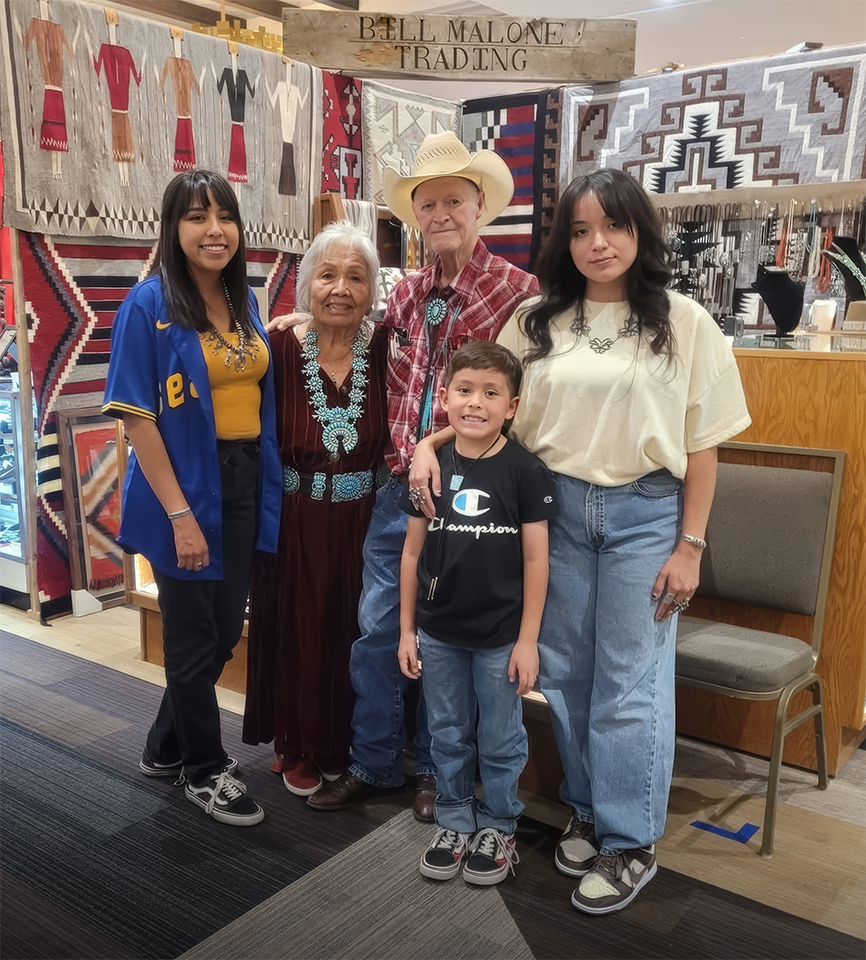
After leaving Hubbell, Billy also worked at the Crystal Forest Museum and Gift Shop at the Petrified Forest National Park in Arizona as well as Shush Yazh Trading in Gallup.  He then opened his own store, Bill Malone Trading in 2009, one of the most respected Native American arts and crafts establishments in Gallup and the Southwest.  The shop is still operated by his family in Gallup.

Billy’s wife and life partner for more than 60 years, Minnie, passed away in June of 2024.  
Bill is survived by his five children, 23 grandchildren and 29 great-grandchildren.

Back in the early 1990s, Billy was a driving force behind the establishment of our Friends of Hubbell organization and its mission.  A central figure in our organization for more than three decades, he continued to provide his wealth of knowledge and expertise on Southwestern Native American culture, arts and crafts, and did so up to the week he passed.  Perhaps long-time Friends of Hubbell board member Jay Mahoney summed up Billy’s life genuinely; “A great man has left us to join his beloved Minnie. Kindness was his trademark! He will not be forgotten by all who knew him. He touched so many lives in so many ways. His life mattered, for he left this world a better place than he was born into.”

Editor’s Note:  In recognition of Billy’s and Minnie’s lifetime of contributions to the Native American community and to our Friends of Hubbell organization, we are naming, in perpetuity, The Billy and Minnie Malone Scholarship in their honor.

Steve and Bill had been the closest of friends for decades. Many adventures and so many stories.  Steve attributes much of his success to Bill.  Now they are together again.

  • Beth Barth
Dye Master at Work!

Dye Master at Work!

Master weaver and dye artist Helen Bia hard at work!

Step 1 - make the dye


Step 2 - add the wool and simmer


Step 3 - let the wool cool and sit to absorb the dye


Step 4 - check the color intensity


Step 5 - once the desired color is achieved, rinse the wool and let dry.


Making natural dyes and hand dying wool in incredibly time consuming.  Very few weavers today take the extra time and effort to hand dye their wool.  

It is a family tradition in certain weaving families along with "secret" family dye recipes. 

Thank you Helen for giving us a glimpse into a day in the life of a Master Navajo Weaver.


Below is the final product!

Chinle : Navajo Rug : Helen Bia : Churro 1703 :

26" x 36" (2'2" x 3') : $4,000


  • Beth Barth
Churro Sheep : Back from the Brink!

Churro Sheep : Back from the Brink!

For hundreds of years Churro sheep have been the center of Navajo life, yet the animal was nearly exterminated by outside forces.  

Steve started working with Navajo weavers in the early 1970s and in the 1980s. He was very interested in improving the Navajo weaving quality by distributing better wools to some of his better weavers. During this time it was New Zealand Romney and Lincoln wools he would distribute to some of the better weavers in the Wide Ruins and surrounding areas. Many of these works were featured in his book The Fine Art of Navajo Weaving.

In the 1990s the economy was not very good and the natural dyes of the Wide Ruin weavers were copied commercially so the uniqueness of their weavings was compromised in value. At this time, Navajo weavings were missing something. Steve met with an old friend, Ray Dewey, in Santa Fe and they discussed how the quality of Navajo weavings could be improved at this point in time. The answer was the wool and the dyes.

The best weaving wool for the Navajo rugs and blankets is the Churro sheep wool. The historic pieces that have been present since over 100 years ago are clear evidence that the Churro wool is the best and only becomes better with time. This conclusion planted the seed to bring Navajo churro wool back to the loom. There were existing efforts to revive the Churro sheep since it was on the endangered species list, but nothing to improve genetics enough to have a high quality weaving wool. Navajo churro wool was the first weaving wool of the Navajo Nation because of its low lanolin content, long staple and translucent qualities. Bringing the churro sheep back to the Navajo weaver and the wool back to the loom was an important goal for Steve and Gail.

Steve was able to find the source of the Navajo Churro Reg

  • Beth Barth
The Start!  We are in the early stages of creating a film of our Navajo weavers and the Navajo Nation!

The Start! We are in the early stages of creating a film of our Navajo weavers and the Navajo Nation!

With the support of our non-profit Forever Navajo, we are in the early stages of a video that will highlight our weavers, the weaving process and the beauty of the Navajo Nation!  We are excited to start the project!  

The project is to preserve and advance the fine art of Navajo weaving.   We envision this will open the Navajo Nation to the world with the ultimate goal of elevating Navajo weaving to the true art form that it deserves.

 
Here are a few location photos.  Stay tuned!

Left to Right:  Lori Cummings, Daisey James,  Elsie Bia and Gail Getzwiller in Canyon de Chelly at Spider Rock.
 

Left to Right:  Steve Wood, Lori Cummings, Gail Getzwiller and Jeff Voracek at the Historic El Rancho Hotel in Gallup NM.
 

Left to Right: Jeff Voracek and Berlinda Nez Barber at Bill Malone Trading.
 
Left to Right:  Judy, Jamie, Laverta, Jalucie, Sean, Lucie and Kathy Marianito, at Kathy's hogan.
 

Kathy Marianito (91 years old!) at her loom.  October 2024
 

Left to Right:  Judy, Jamie, Jalucie, Sean, Laverta, Kathy and Lucie Marianito.  Jeff Voracek and Steve Wood in the rear, on the Navajo Nation.


  • Beth Barth
Master Weaver Elsie Bia weaves live!

Master Weaver Elsie Bia weaves live!


On October 12 & 13 we were very blessed to have Master Weaver Elsie Bia weave live as part of the The Getzwiller Exhibit held at the Bowman - Stradling History Center at the Santa Cruz County Fairgrounds.

Elsie also gave a lesson to Gail!


  • Beth Barth