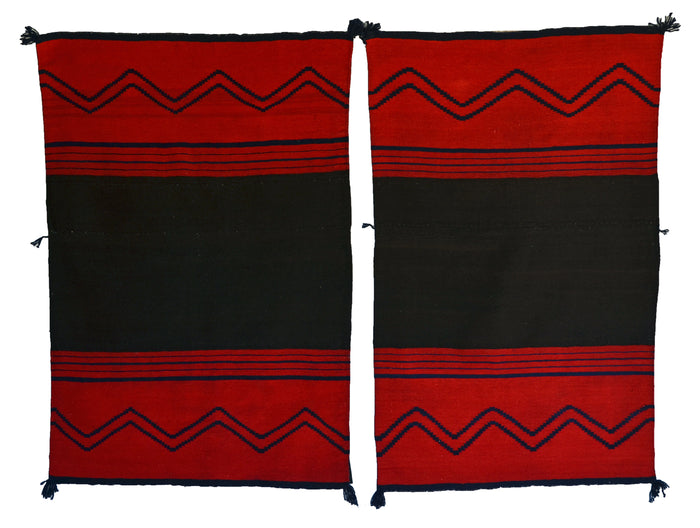
Serape
- Style
- Serape
- Weaver
- Historic
- Size
- 54" x 76"
- Item number
- GHT 778
About this weaving
Exquisite serape featuring Merino wool, red background is 3 ply raveled American Flannel and Bayeta cloth. Natural dyed Indigo blue with plied yellow and orange. Greens may be plied or home spun natural dyed with rabbit brush yellow and then dipped in an Indigo blue bath.
Colors are Indigo blue with plied yellow-green-orange-brown.
The art of plying was done when threads were unraveled from from bolts of flannel (American made cloth) or Bayeta cloth (imported from Europe) and then re-spun together into a 3-ply yarn that could be woven on the traditional Navajo upright Loom.
From an 1896 book, Dr Lummis describes Bayeta weavings as, "The Navahos used to ravel this cloth and use the thread for their finest blankets; and it made such blankets as never have been produced elsewhere. Their durability is wonderful. They never fade, no matter how frequently washed—an operation in which amole, the saponaceous root of the Palmilla, should be substituted for soap. As for wear, I have seen the latter blankets which have been used for rugs on the floors of populous Mexican houses for fifty years, which still retain their brilliant color, and show serious wear only at their broken edges. And they will hold water as well as canvas will.
A balleta (Bayeta) blanket like that pictured elsewhere is worth $200 and not a dozen of them could be bought at any price today. It is seventy-three inches long by fifty-six inches wide and weighs six pounds. You can easily reckon that the thread in it cost something, at $6 a pound, and the weaving occupied a Navaho woman for many months. It is hardly thicker than an ordinary book cover, and is almost as firm. It is too thin and stiff to be an ideal bed-blanket, and it was never meant to be one. All blankets of that quality were made to be worn on the shoulders of chiefs; and most of them were ponchos—that is, they had a small slit left in the center for the wearer to put his head through, so that the blanket would hang upon him like a cape. Thus it was combined overcoat, water-proof, and adornment."
Rainbow bars, crosses (stars) rivers or lightning zig-zags, are all very important in the life of the Navajo Indian. These powerful symbols once told a story that is a mystery today.
This blanket, possibly 150 years old, is a rare opportunity to own part of the Native American History. During the early pioneer days the Navajo would trade with other Indian Tribes and the Cavalry. A single Navajo Blanket was sometimes traded for many horses or as much as $50 in gold. A Navajo blanket was highly prized and valuable, as they were so tightly woven they could save a life, keeping the owner warm and dry in a rain or snowstorm.
This particular weaving is expertly woven and as all Navajo Weavers incorporated art into life. The combinations of color and design elements reveal a complex yet geometrically simple art statement. Navajos were the pioneers of Modern Art.
This weaving was part of NAVAJO NATION EXHIBIT, "Collection of Steve Getzwiller" Exhibition at the Tubac Center for the Arts
Tubac Arizona 2014
This weaving is part of Art & History Woven Together
The Getzwiller Collection of Antique Navajo Weavings
'The Steve and Gail Getzwiller Historic Navajo Textile Exhibition at the Desert Caballeros Western Museum in Wickenburg Arizona' 1999
| Style | Wearables: Manta, Serape, Child |
| Weaver | Unknown Navajo |
| Date | circa 1870's |
| Size | 54″ x 76″ (4'6" x 6'4") |
| Item # | GHT 778 |
| Learn more about wearable weavings | |
Contact us for more information at nizhoniranch@gmail.com or 520-455-5020 -- We will be glad to help you!
Nizhoni Ranch Gallery donates a portion of each sale to the Forever Navajo Foundation. Forever Navajo's primary purpose is to preserve the fine art of Navajo weaving.
Shipping and viewing
Fully insured shipping, or see it in person at the gallery in Sonoita by appointment. Call 520-455-5020.
Learn about Navajo weaving
New to Navajo weaving? The gallery's journal explains the regional styles, Churro wool, and how to care for and hang a rug. Read the articles or watch the videos.