
We are open by appointment only, email or call us to book your appointment today!

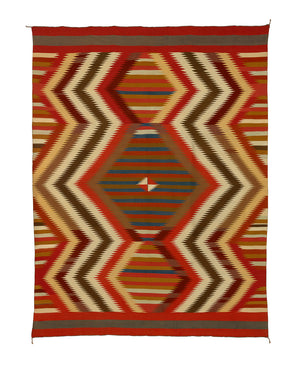
The eyed dazzler style of weaving emerged in the last quarter of the 1880's during a period of difficult transition for the Navajo.  They were adjusting to their new life on the reservation after a devastating four-year forced confinement by the United States government at Bosque Redondo, a desolate area on the Pecos River in eastern New Mexico.

During Bosque Redondo, nearly one in four people would die due to malnutrition, exposure or rampant illness.  in 1868, they were allowed to return to their ancestral lands in Northeastern Arizona and Northwestern New Mexico.  However, they  were no longer able to provide for themselves without assistance from the U.S. government;  Keith Carson had destroyed their crops, poisoned their water holes, stolen their horses and killed their shop years earlier in an effort to starve the Navajo into submission.  

These radical hardships affected all areas of Navajo life, including their weaving.  Since the majority of Navajo weavers no longer had their Churro sheep on the reservation, most Navajo women could no longer clean, card and spin their own yarns, which forced them to search elsewhere for materials.  In the 1870's , there were two main sources of material available on the reservation for weaving:  Germantown yarns and unraveled yarns from coarse American flannel cloth called Bayeta.  Germantown yarns were synthetically-dyed, commercial yarns. 

A catalog was printed to preserve the exhibit, as some pieces find new homes.

Weavings featured in the Dazzled Eye Exhibit which are available for sale are listed below. As always, if you have any questions please call us at 520-455-5020.

Dazzled Eye Navajo Rug Weaving Exhibit
Sort by:
Filter
{"id":453820907551,"title":"Historic Navajo Serape with Spider Woman Hole: PC 258 : 57″ x 75.5″ (4'9\" x 5'11.5\")","handle":"historic-navajo-serape-with-spider-woman-hole-pc-258","description":"\u003cblockquote\u003e\n\u003cp\u003eThis extremely rare serape blanket with a Spiderwoman hole in its center was likely woven at Bosque Redondo.  This particular palette of colors was only available at Bosque Redondo and Fort Wingate during this time frame.\u003cbr\u003eThe Navajo did not have sheep during this time of captivity, so this blanket is made of commercial yarn, three-ply Saxony, which would have come over the Santa Fe Trail.  All natural dyes were used including cochineal red and Indigo blue.  \u003cbr\u003e\u003cspan\u003e \u003c\/span\u003eSaxony was highly prized in the 18th and 19th centuries, Saxony became famous for exceptionally fine merino sheep, introduced from Spain and carefully bred.  Textiles labeled \"Saxony\": signaled luxury, refinement, and quality.\u003c\/p\u003e\n\u003cp\u003eThe blue is very important because that is the sacred directional color to the Navajo, and this was a time when their thoughts were always directed towards their true home.  Even the warp is Indigo dyed.\u003cbr\u003e\u003c\/p\u003e\n\u003cp\u003eIn the center of this piece is what's known as a spider woman hole, which some believe the wearer would hide behind and look to see if the enemy was coming.  Spider Woman is the mythological helper and protector of the Dine, and was also the one who taught the first weavers their craft.  This blanket has square plated end tassels, and there are probably only eight other examples like this known.  The design would have been influenced by Spanish blankets.  The Navajos often borrowed from other cultures and adapted it into their own.  \u003c\/p\u003e\n\u003cp\u003eThis weaving was part of several exhibitions:\u003c\/p\u003e\n\u003cp\u003e\u003cstrong\u003e\u003cspan\u003eColor Riot! How Color Changed Navajo Textiles April 5,2019 - September 2,2019 at the Heard Museum Phoenix AZ. \u003cbr\u003eMuseum of Fine Arts, St. Petersburg Florida, 9\/05\/2020 -3\/15\/2021\u003cbr\u003eMontclair Art Museum, New Jersey.  9\/10\/2021 - 01\/02\/2022\u003c\/span\u003e\u003c\/strong\u003e\u003c\/p\u003e\n\u003cp\u003e\u003cem\u003e\u003cstrong\u003eOne Trader's Legacy: Steve Getzwiller Collects the West : \u003c\/strong\u003e \u003cstrong\u003eDesert Caballeros Western Museum\u003c\/strong\u003e November\u003c\/em\u003e\u003cem\u003e 18, 2017 to June 3, 2018.  \u003c\/em\u003e\u003c\/p\u003e\n\u003cp\u003e\u003cem\u003e\u003cstrong\u003eThe Dazzled Eye at the\u003c\/strong\u003e \u003cstrong\u003eTucson Desert Art Museum, Tucson Arizona\u003c\/strong\u003e\u003cspan\u003e \u003c\/span\u003eJanuary 4 2017 to May 30 2017.\u003c\/em\u003e\u003c\/p\u003e\n\u003cp style=\"text-align: center;\"\u003e\u003cstrong\u003e\u003cem\u003e\u003cbr\u003e\u003c\/em\u003e\u003c\/strong\u003e\u003c\/p\u003e\n\u003c\/blockquote\u003e\n\u003ctable style=\"width: 369px;\"\u003e\n\u003ctbody\u003e\n\u003ctr\u003e\n\u003ctd style=\"width: 92px; text-align: left;\"\u003eStyle\u003c\/td\u003e\n\u003ctd style=\"width: 263px; text-align: left;\"\u003eWearables: Manta, Serape\u003c\/td\u003e\n\u003c\/tr\u003e\n\u003ctr style=\"text-align: left;\"\u003e\n\u003ctd style=\"width: 92px;\"\u003eWeaver\u003c\/td\u003e\n\u003ctd style=\"width: 263px;\"\u003eUnknown Navajo\u003c\/td\u003e\n\u003c\/tr\u003e\n\u003ctr style=\"text-align: left;\"\u003e\n\u003ctd style=\"width: 92px;\"\u003eDate\u003c\/td\u003e\n\u003ctd style=\"width: 263px;\"\u003ecirca 1865-1870's\u003c\/td\u003e\n\u003c\/tr\u003e\n\u003ctr style=\"text-align: left;\"\u003e\n\u003ctd style=\"width: 92px;\"\u003eSize\u003c\/td\u003e\n\u003ctd style=\"width: 263px;\"\u003e57″ x 75.5″ (4'9\" x 5'11.5\")\u003c\/td\u003e\n\u003c\/tr\u003e\n\u003ctr style=\"text-align: left;\"\u003e\n\u003ctd style=\"width: 92px;\"\u003eItem #\u003c\/td\u003e\n\u003ctd style=\"width: 263px;\"\u003ePC 258\u003c\/td\u003e\n\u003c\/tr\u003e\n\u003ctr\u003e\n\u003ctd style=\"width: 355px; text-align: left;\" colspan=\"2\"\u003e\u003ca href=\"https:\/\/navajorug-com.myshopify.com\/pages\/wearables\"\u003eLearn more about wearable weavings\u003c\/a\u003e\u003c\/td\u003e\n\u003c\/tr\u003e\n\u003c\/tbody\u003e\n\u003c\/table\u003e\n\u003cp\u003e\u003cspan\u003eContact us for more information at nizhoniranch@gmail.com \u003c\/span\u003e\u003cspan\u003eor 520-455-5020 -- We will be glad to help you!\u003c\/span\u003e\u003c\/p\u003e\n\u003cp\u003e\u003cspan\u003eNizhoni Ranch Gallery donates a portion of each sale to the \u003ca href=\"https:\/\/www.navajorug.com\/pages\/forever-navajo\" title=\"Forever Navajo Foundation\"\u003eForever Navajo Foundation\u003c\/a\u003e.  Forever Navajo's primary purpose is to preserve the fine art of Navajo weaving.\u003c\/span\u003e\u003c\/p\u003e","published_at":"2019-06-12T09:45:21-07:00","created_at":"2018-03-01T14:16:20-07:00","vendor":"Historic Collection","type":"Serape","tags":["4 x 6","5 x 6","Antique Navajo Rugs","circa-1860","color blue","color green","color orange","color riot","dazzled-eye-exhibit","Filter by Price_$40000 and above","Filter by Size_Medium","green","heard","medium","Navajo Rugs","Navajo rugs circa_1870-1890","orange","reduced","serape","Size 4 x 6","size 5 x 6","wearing blanket"],"price":8500000,"price_min":8500000,"price_max":8500000,"available":true,"price_varies":false,"compare_at_price":0,"compare_at_price_min":0,"compare_at_price_max":0,"compare_at_price_varies":false,"variants":[{"id":5596880994335,"title":"Default Title","option1":"Default Title","option2":null,"option3":null,"sku":"PP-pension","requires_shipping":true,"taxable":true,"featured_image":null,"available":true,"name":"Historic Navajo Serape with Spider Woman Hole: PC 258 : 57″ x 75.5″ (4'9\" x 5'11.5\")","public_title":null,"options":["Default Title"],"price":8500000,"weight":0,"compare_at_price":0,"inventory_quantity":1,"inventory_management":"shopify","inventory_policy":"deny","barcode":"paid 35K","requires_selling_plan":false,"selling_plan_allocations":[]}],"images":["\/\/www.navajorug.com\/cdn\/shop\/products\/historic-navajo-serape-with-spider-woman-hole.jpg?v=1579875025","\/\/www.navajorug.com\/cdn\/shop\/products\/color-riot-how-color-changed-navajo-textiles-open-april-2019-at-the-heard-museum.jpg?v=1579875025","\/\/www.navajorug.com\/cdn\/shop\/products\/navajo-serape-with-spider-woman-hole-woven-nation-exhibit-tubac-az.jpg?v=1579875025"],"featured_image":"\/\/www.navajorug.com\/cdn\/shop\/products\/historic-navajo-serape-with-spider-woman-hole.jpg?v=1579875025","options":["Title"],"media":[{"alt":"A colorful Navajo serape blanket featuring geometric patterns with a prominent Spider Woman hole in the center.","id":1082114539592,"position":1,"preview_image":{"aspect_ratio":0.82,"height":1400,"width":1148,"src":"\/\/www.navajorug.com\/cdn\/shop\/products\/historic-navajo-serape-with-spider-woman-hole.jpg?v=1579875025"},"aspect_ratio":0.82,"height":1400,"media_type":"image","src":"\/\/www.navajorug.com\/cdn\/shop\/products\/historic-navajo-serape-with-spider-woman-hole.jpg?v=1579875025","width":1148},{"alt":"A colorful Navajo serape blanket featuring geometric patterns with a prominent Spider Woman hole in the center.","id":1082120634440,"position":2,"preview_image":{"aspect_ratio":0.75,"height":1400,"width":1050,"src":"\/\/www.navajorug.com\/cdn\/shop\/products\/color-riot-how-color-changed-navajo-textiles-open-april-2019-at-the-heard-museum.jpg?v=1579875025"},"aspect_ratio":0.75,"height":1400,"media_type":"image","src":"\/\/www.navajorug.com\/cdn\/shop\/products\/color-riot-how-color-changed-navajo-textiles-open-april-2019-at-the-heard-museum.jpg?v=1579875025","width":1050},{"alt":"Gathering at the Color Riot Exhibition with Getwiller collection on display","id":1082129481800,"position":3,"preview_image":{"aspect_ratio":1.508,"height":398,"width":600,"src":"\/\/www.navajorug.com\/cdn\/shop\/products\/navajo-serape-with-spider-woman-hole-woven-nation-exhibit-tubac-az.jpg?v=1579875025"},"aspect_ratio":1.508,"height":398,"media_type":"image","src":"\/\/www.navajorug.com\/cdn\/shop\/products\/navajo-serape-with-spider-woman-hole-woven-nation-exhibit-tubac-az.jpg?v=1579875025","width":600}],"requires_selling_plan":false,"selling_plan_groups":[],"content":"\u003cblockquote\u003e\n\u003cp\u003eThis extremely rare serape blanket with a Spiderwoman hole in its center was likely woven at Bosque Redondo.  This particular palette of colors was only available at Bosque Redondo and Fort Wingate during this time frame.\u003cbr\u003eThe Navajo did not have sheep during this time of captivity, so this blanket is made of commercial yarn, three-ply Saxony, which would have come over the Santa Fe Trail.  All natural dyes were used including cochineal red and Indigo blue.  \u003cbr\u003e\u003cspan\u003e \u003c\/span\u003eSaxony was highly prized in the 18th and 19th centuries, Saxony became famous for exceptionally fine merino sheep, introduced from Spain and carefully bred.  Textiles labeled \"Saxony\": signaled luxury, refinement, and quality.\u003c\/p\u003e\n\u003cp\u003eThe blue is very important because that is the sacred directional color to the Navajo, and this was a time when their thoughts were always directed towards their true home.  Even the warp is Indigo dyed.\u003cbr\u003e\u003c\/p\u003e\n\u003cp\u003eIn the center of this piece is what's known as a spider woman hole, which some believe the wearer would hide behind and look to see if the enemy was coming.  Spider Woman is the mythological helper and protector of the Dine, and was also the one who taught the first weavers their craft.  This blanket has square plated end tassels, and there are probably only eight other examples like this known.  The design would have been influenced by Spanish blankets.  The Navajos often borrowed from other cultures and adapted it into their own.  \u003c\/p\u003e\n\u003cp\u003eThis weaving was part of several exhibitions:\u003c\/p\u003e\n\u003cp\u003e\u003cstrong\u003e\u003cspan\u003eColor Riot! How Color Changed Navajo Textiles April 5,2019 - September 2,2019 at the Heard Museum Phoenix AZ. \u003cbr\u003eMuseum of Fine Arts, St. Petersburg Florida, 9\/05\/2020 -3\/15\/2021\u003cbr\u003eMontclair Art Museum, New Jersey.  9\/10\/2021 - 01\/02\/2022\u003c\/span\u003e\u003c\/strong\u003e\u003c\/p\u003e\n\u003cp\u003e\u003cem\u003e\u003cstrong\u003eOne Trader's Legacy: Steve Getzwiller Collects the West : \u003c\/strong\u003e \u003cstrong\u003eDesert Caballeros Western Museum\u003c\/strong\u003e November\u003c\/em\u003e\u003cem\u003e 18, 2017 to June 3, 2018.  \u003c\/em\u003e\u003c\/p\u003e\n\u003cp\u003e\u003cem\u003e\u003cstrong\u003eThe Dazzled Eye at the\u003c\/strong\u003e \u003cstrong\u003eTucson Desert Art Museum, Tucson Arizona\u003c\/strong\u003e\u003cspan\u003e \u003c\/span\u003eJanuary 4 2017 to May 30 2017.\u003c\/em\u003e\u003c\/p\u003e\n\u003cp style=\"text-align: center;\"\u003e\u003cstrong\u003e\u003cem\u003e\u003cbr\u003e\u003c\/em\u003e\u003c\/strong\u003e\u003c\/p\u003e\n\u003c\/blockquote\u003e\n\u003ctable style=\"width: 369px;\"\u003e\n\u003ctbody\u003e\n\u003ctr\u003e\n\u003ctd style=\"width: 92px; text-align: left;\"\u003eStyle\u003c\/td\u003e\n\u003ctd style=\"width: 263px; text-align: left;\"\u003eWearables: Manta, Serape\u003c\/td\u003e\n\u003c\/tr\u003e\n\u003ctr style=\"text-align: left;\"\u003e\n\u003ctd style=\"width: 92px;\"\u003eWeaver\u003c\/td\u003e\n\u003ctd style=\"width: 263px;\"\u003eUnknown Navajo\u003c\/td\u003e\n\u003c\/tr\u003e\n\u003ctr style=\"text-align: left;\"\u003e\n\u003ctd style=\"width: 92px;\"\u003eDate\u003c\/td\u003e\n\u003ctd style=\"width: 263px;\"\u003ecirca 1865-1870's\u003c\/td\u003e\n\u003c\/tr\u003e\n\u003ctr style=\"text-align: left;\"\u003e\n\u003ctd style=\"width: 92px;\"\u003eSize\u003c\/td\u003e\n\u003ctd style=\"width: 263px;\"\u003e57″ x 75.5″ (4'9\" x 5'11.5\")\u003c\/td\u003e\n\u003c\/tr\u003e\n\u003ctr style=\"text-align: left;\"\u003e\n\u003ctd style=\"width: 92px;\"\u003eItem #\u003c\/td\u003e\n\u003ctd style=\"width: 263px;\"\u003ePC 258\u003c\/td\u003e\n\u003c\/tr\u003e\n\u003ctr\u003e\n\u003ctd style=\"width: 355px; text-align: left;\" colspan=\"2\"\u003e\u003ca href=\"https:\/\/navajorug-com.myshopify.com\/pages\/wearables\"\u003eLearn more about wearable weavings\u003c\/a\u003e\u003c\/td\u003e\n\u003c\/tr\u003e\n\u003c\/tbody\u003e\n\u003c\/table\u003e\n\u003cp\u003e\u003cspan\u003eContact us for more information at nizhoniranch@gmail.com \u003c\/span\u003e\u003cspan\u003eor 520-455-5020 -- We will be glad to help you!\u003c\/span\u003e\u003c\/p\u003e\n\u003cp\u003e\u003cspan\u003eNizhoni Ranch Gallery donates a portion of each sale to the \u003ca href=\"https:\/\/www.navajorug.com\/pages\/forever-navajo\" title=\"Forever Navajo Foundation\"\u003eForever Navajo Foundation\u003c\/a\u003e.  Forever Navajo's primary purpose is to preserve the fine art of Navajo weaving.\u003c\/span\u003e\u003c\/p\u003e"}
A colorful Navajo serape blanket featuring geometric patterns with a prominent Spider Woman hole in the center.

Historic Navajo Serape with Spider Woman Hole: PC 258 : 57″ x 75.5″ (4'9" x 5'11.5")

$ 85,000.00

This extremely rare serape blanket with a Spiderwoman hole in its center was likely woven at Bosque Redondo.  This particular palette of colors was only available at Bosque Redondo and Fort Wingate during this time frame.The Navajo did not have sheep during this time of captivity, so this blanket is made of commercial yarn, three-ply Saxony, wh...


More Info