
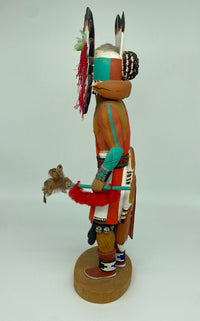
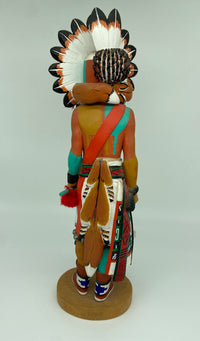

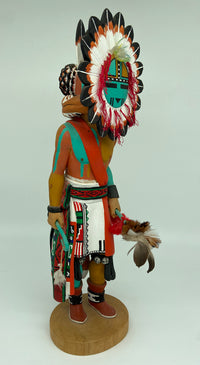


Katsina : Sunface : Lowell Talashoma
About this weaving
Sunface Katsina by award winner artist Lowell Talashoma.
Object : Katsina (Katchina)
Title : Sunface (Tawa)
Carver : Lowell Talashoma.
Origin : Hopi
Size : 16"
Materials : Wood, paint, string, yarn and feathers
The Sunface Katsina, known as Tawa, represents many things including the sun’s warmth, hope of shelter for the elderly, and a bright future full of playfulness for the young. The sun is also essential for the growth of crops.
The Sunface Katsinam sometimes appears with the Morning Singer Katsinam in welcoming the sun as it rises above the horizon. This group will stand on housetops to perform their rituals. The Sunface Katsina also appears in winter dance ceremonies to pray for the Sun’s speedy return and in the Mixed Dances to celebrate his warmth and light.
The coloration of the Sunface Katsina mask is important. The top half of the mask represents the colors that appear at first light; the lower half of the mask represents the colors of the full sun after it has risen.
The Sunface Katsina, like many of the Hopi Katsinam, represents a celestial body that the Hopi use as a guide for when to plant their very important life-sustaining crops. Without the light and warmth that the Sun radiates all would perish.
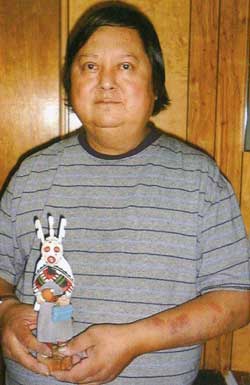
Lowell Talashoma Sr
Central to Hopi religion, Katsinas are supernatural beings believed to live on the San Francisco Peaks near Flagstaff, Arizona. Hopi men embody the Katsina spirits during ceremonies that take place between Winter Solstice and mid-July. The Hopis believe these spirits enable them to live in harmony with nature, ensuring rain, crops, fertility, and good hunting. The Hopi men embody the spirits of these Katsinas by wearing masks and dancing in the plazas of the villages. The dolls, which are carved replicas of the dancers, are given to the children so that they may learn about their people's traditions. The art of carving Katsina dolls has evolved from the old-style block-like figures into today's highly detailed, all-wood dolls with realistic form and action.
Over time, Katsina Dolls became more and more sophisticated and included bases for the dolls to stand on and showing the Katsina in “action”- such as dancing or hunting. All Katsina Dolls are carved out of the root of the Cottonwood tree. The Cottonwood tree’s vigorous roots travel far and deep in search of water. There is spiritual importance in this fact, as the Hopis are dry farmers in an arid part of Arizona and the search for water is of critical importance to their culture.
Shipping and viewing
Fully insured shipping, or see it in person at the gallery in Sonoita by appointment. Call 520-455-5020.
Learn about Navajo weaving
New to Navajo weaving? The gallery's journal explains the regional styles, Churro wool, and how to care for and hang a rug. Read the articles or watch the videos.


