We are open by appointment only, email or call us to book your appointment today!
{"id":453820907551,"title":"Historic Navajo Serape with Spider Woman Hole: PC 258 : 57″ x 75.5″ (4'9\" x 5'11.5\")","handle":"historic-navajo-serape-with-spider-woman-hole-pc-258","description":"\u003cblockquote\u003e\n\u003cp\u003eThis extremely rare serape blanket with a Spiderwoman hole in its center was likely woven at Bosque Redondo.  This particular palette of colors was only available at Bosque Redondo and Fort Wingate during this time frame.\u003cbr\u003eThe Navajo did not have sheep during this time of captivity, so this blanket is made of commercial yarn, three-ply Saxony, which would have come over the Santa Fe Trail.  All natural dyes were used including cochineal red and Indigo blue.  \u003cbr\u003e\u003cspan\u003e \u003c\/span\u003eSaxony was highly prized in the 18th and 19th centuries, Saxony became famous for exceptionally fine merino sheep, introduced from Spain and carefully bred.  Textiles labeled \"Saxony\": signaled luxury, refinement, and quality.\u003c\/p\u003e\n\u003cp\u003eThe blue is very important because that is the sacred directional color to the Navajo, and this was a time when their thoughts were always directed towards their true home.  Even the warp is Indigo dyed.\u003cbr\u003e\u003c\/p\u003e\n\u003cp\u003eIn the center of this piece is what's known as a spider woman hole, which some believe the wearer would hide behind and look to see if the enemy was coming.  Spider Woman is the mythological helper and protector of the Dine, and was also the one who taught the first weavers their craft.  This blanket has square plated end tassels, and there are probably only eight other examples like this known.  The design would have been influenced by Spanish blankets.  The Navajos often borrowed from other cultures and adapted it into their own.  \u003c\/p\u003e\n\u003cp\u003eThis weaving was part of several exhibitions:\u003c\/p\u003e\n\u003cp\u003e\u003cstrong\u003e\u003cspan\u003eColor Riot! How Color Changed Navajo Textiles April 5,2019 - September 2,2019 at the Heard Museum Phoenix AZ. \u003cbr\u003eMuseum of Fine Arts, St. Petersburg Florida, 9\/05\/2020 -3\/15\/2021\u003cbr\u003eMontclair Art Museum, New Jersey.  9\/10\/2021 - 01\/02\/2022\u003c\/span\u003e\u003c\/strong\u003e\u003c\/p\u003e\n\u003cp\u003e\u003cem\u003e\u003cstrong\u003eOne Trader's Legacy: Steve Getzwiller Collects the West : \u003c\/strong\u003e \u003cstrong\u003eDesert Caballeros Western Museum\u003c\/strong\u003e November\u003c\/em\u003e\u003cem\u003e 18, 2017 to June 3, 2018.  \u003c\/em\u003e\u003c\/p\u003e\n\u003cp\u003e\u003cem\u003e\u003cstrong\u003eThe Dazzled Eye at the\u003c\/strong\u003e \u003cstrong\u003eTucson Desert Art Museum, Tucson Arizona\u003c\/strong\u003e\u003cspan\u003e \u003c\/span\u003eJanuary 4 2017 to May 30 2017.\u003c\/em\u003e\u003c\/p\u003e\n\u003cp style=\"text-align: center;\"\u003e\u003cstrong\u003e\u003cem\u003e\u003cbr\u003e\u003c\/em\u003e\u003c\/strong\u003e\u003c\/p\u003e\n\u003c\/blockquote\u003e\n\u003ctable style=\"width: 369px;\"\u003e\n\u003ctbody\u003e\n\u003ctr\u003e\n\u003ctd style=\"width: 92px; text-align: left;\"\u003eStyle\u003c\/td\u003e\n\u003ctd style=\"width: 263px; text-align: left;\"\u003eWearables: Manta, Serape\u003c\/td\u003e\n\u003c\/tr\u003e\n\u003ctr style=\"text-align: left;\"\u003e\n\u003ctd style=\"width: 92px;\"\u003eWeaver\u003c\/td\u003e\n\u003ctd style=\"width: 263px;\"\u003eUnknown Navajo\u003c\/td\u003e\n\u003c\/tr\u003e\n\u003ctr style=\"text-align: left;\"\u003e\n\u003ctd style=\"width: 92px;\"\u003eDate\u003c\/td\u003e\n\u003ctd style=\"width: 263px;\"\u003ecirca 1865-1870's\u003c\/td\u003e\n\u003c\/tr\u003e\n\u003ctr style=\"text-align: left;\"\u003e\n\u003ctd style=\"width: 92px;\"\u003eSize\u003c\/td\u003e\n\u003ctd style=\"width: 263px;\"\u003e57″ x 75.5″ (4'9\" x 5'11.5\")\u003c\/td\u003e\n\u003c\/tr\u003e\n\u003ctr style=\"text-align: left;\"\u003e\n\u003ctd style=\"width: 92px;\"\u003eItem #\u003c\/td\u003e\n\u003ctd style=\"width: 263px;\"\u003ePC 258\u003c\/td\u003e\n\u003c\/tr\u003e\n\u003ctr\u003e\n\u003ctd colspan=\"2\" style=\"width: 355px; text-align: left;\"\u003e\u003ca href=\"https:\/\/navajorug-com.myshopify.com\/pages\/wearables\"\u003eLearn more about wearable weavings\u003c\/a\u003e\u003c\/td\u003e\n\u003c\/tr\u003e\n\u003c\/tbody\u003e\n\u003c\/table\u003e\n\u003cp\u003e\u003cspan\u003eContact us for more information, pricing or to order – \u003ca href=\"mailto:steve@navajorug.com\" target=\"_blank\"\u003esteve@navajorug.com\u003c\/a\u003e or 520-455-5020 -- We will be glad to help you!\u003c\/span\u003e\u003c\/p\u003e\n\u003cp\u003e\u003cspan\u003eA unique blend of history, Native American culture and storytelling make these weavings an art like no other. \u003c\/span\u003e\u003c\/p\u003e","published_at":"2019-06-12T09:45:21-07:00","created_at":"2018-03-01T14:16:20-07:00","vendor":"Historic Collection","type":"Serape","tags":["4 x 6","5 x 6","Antique Navajo Rugs","circa-1860","color blue","color green","color orange","color riot","dazzled-eye-exhibit","Filter by Price_$40000 and above","Filter by Size_Medium","green","heard","medium","Navajo Rugs","Navajo rugs circa_1870-1890","orange","reduced","serape","Size 4 x 6","size 5 x 6","wearing blanket"],"price":8500000,"price_min":8500000,"price_max":8500000,"available":true,"price_varies":false,"compare_at_price":0,"compare_at_price_min":0,"compare_at_price_max":0,"compare_at_price_varies":false,"variants":[{"id":5596880994335,"title":"Default Title","option1":"Default Title","option2":null,"option3":null,"sku":"PP-pension","requires_shipping":true,"taxable":true,"featured_image":null,"available":true,"name":"Historic Navajo Serape with Spider Woman Hole: PC 258 : 57″ x 75.5″ (4'9\" x 5'11.5\")","public_title":null,"options":["Default Title"],"price":8500000,"weight":0,"compare_at_price":0,"inventory_quantity":1,"inventory_management":"shopify","inventory_policy":"deny","barcode":"paid 35K","requires_selling_plan":false,"selling_plan_allocations":[]}],"images":["\/\/www.navajorug.com\/cdn\/shop\/products\/historic-navajo-serape-with-spider-woman-hole.jpg?v=1579875025","\/\/www.navajorug.com\/cdn\/shop\/products\/color-riot-how-color-changed-navajo-textiles-open-april-2019-at-the-heard-museum.jpg?v=1579875025","\/\/www.navajorug.com\/cdn\/shop\/products\/navajo-serape-with-spider-woman-hole-woven-nation-exhibit-tubac-az.jpg?v=1579875025"],"featured_image":"\/\/www.navajorug.com\/cdn\/shop\/products\/historic-navajo-serape-with-spider-woman-hole.jpg?v=1579875025","options":["Title"],"media":[{"alt":"Historic Navajo Serape with Spider Woman Hole: PC 258 : 57″ x 75.5″ - Getzwiller's Nizhoni Ranch Gallery","id":1082114539592,"position":1,"preview_image":{"aspect_ratio":0.82,"height":1400,"width":1148,"src":"\/\/www.navajorug.com\/cdn\/shop\/products\/historic-navajo-serape-with-spider-woman-hole.jpg?v=1579875025"},"aspect_ratio":0.82,"height":1400,"media_type":"image","src":"\/\/www.navajorug.com\/cdn\/shop\/products\/historic-navajo-serape-with-spider-woman-hole.jpg?v=1579875025","width":1148},{"alt":"Historic Navajo Serape with Spider Woman Hole: PC 258 : 57″ x 75.5″ - Getzwiller's Nizhoni Ranch Gallery","id":1082120634440,"position":2,"preview_image":{"aspect_ratio":0.75,"height":1400,"width":1050,"src":"\/\/www.navajorug.com\/cdn\/shop\/products\/color-riot-how-color-changed-navajo-textiles-open-april-2019-at-the-heard-museum.jpg?v=1579875025"},"aspect_ratio":0.75,"height":1400,"media_type":"image","src":"\/\/www.navajorug.com\/cdn\/shop\/products\/color-riot-how-color-changed-navajo-textiles-open-april-2019-at-the-heard-museum.jpg?v=1579875025","width":1050},{"alt":"Historic Navajo Serape with Spider Woman Hole: PC 258 : 57″ x 75.5″ - Getzwiller's Nizhoni Ranch Gallery","id":1082129481800,"position":3,"preview_image":{"aspect_ratio":1.508,"height":398,"width":600,"src":"\/\/www.navajorug.com\/cdn\/shop\/products\/navajo-serape-with-spider-woman-hole-woven-nation-exhibit-tubac-az.jpg?v=1579875025"},"aspect_ratio":1.508,"height":398,"media_type":"image","src":"\/\/www.navajorug.com\/cdn\/shop\/products\/navajo-serape-with-spider-woman-hole-woven-nation-exhibit-tubac-az.jpg?v=1579875025","width":600}],"requires_selling_plan":false,"selling_plan_groups":[],"content":"\u003cblockquote\u003e\n\u003cp\u003eThis extremely rare serape blanket with a Spiderwoman hole in its center was likely woven at Bosque Redondo.  This particular palette of colors was only available at Bosque Redondo and Fort Wingate during this time frame.\u003cbr\u003eThe Navajo did not have sheep during this time of captivity, so this blanket is made of commercial yarn, three-ply Saxony, which would have come over the Santa Fe Trail.  All natural dyes were used including cochineal red and Indigo blue.  \u003cbr\u003e\u003cspan\u003e \u003c\/span\u003eSaxony was highly prized in the 18th and 19th centuries, Saxony became famous for exceptionally fine merino sheep, introduced from Spain and carefully bred.  Textiles labeled \"Saxony\": signaled luxury, refinement, and quality.\u003c\/p\u003e\n\u003cp\u003eThe blue is very important because that is the sacred directional color to the Navajo, and this was a time when their thoughts were always directed towards their true home.  Even the warp is Indigo dyed.\u003cbr\u003e\u003c\/p\u003e\n\u003cp\u003eIn the center of this piece is what's known as a spider woman hole, which some believe the wearer would hide behind and look to see if the enemy was coming.  Spider Woman is the mythological helper and protector of the Dine, and was also the one who taught the first weavers their craft.  This blanket has square plated end tassels, and there are probably only eight other examples like this known.  The design would have been influenced by Spanish blankets.  The Navajos often borrowed from other cultures and adapted it into their own.  \u003c\/p\u003e\n\u003cp\u003eThis weaving was part of several exhibitions:\u003c\/p\u003e\n\u003cp\u003e\u003cstrong\u003e\u003cspan\u003eColor Riot! How Color Changed Navajo Textiles April 5,2019 - September 2,2019 at the Heard Museum Phoenix AZ. \u003cbr\u003eMuseum of Fine Arts, St. Petersburg Florida, 9\/05\/2020 -3\/15\/2021\u003cbr\u003eMontclair Art Museum, New Jersey.  9\/10\/2021 - 01\/02\/2022\u003c\/span\u003e\u003c\/strong\u003e\u003c\/p\u003e\n\u003cp\u003e\u003cem\u003e\u003cstrong\u003eOne Trader's Legacy: Steve Getzwiller Collects the West : \u003c\/strong\u003e \u003cstrong\u003eDesert Caballeros Western Museum\u003c\/strong\u003e November\u003c\/em\u003e\u003cem\u003e 18, 2017 to June 3, 2018.  \u003c\/em\u003e\u003c\/p\u003e\n\u003cp\u003e\u003cem\u003e\u003cstrong\u003eThe Dazzled Eye at the\u003c\/strong\u003e \u003cstrong\u003eTucson Desert Art Museum, Tucson Arizona\u003c\/strong\u003e\u003cspan\u003e \u003c\/span\u003eJanuary 4 2017 to May 30 2017.\u003c\/em\u003e\u003c\/p\u003e\n\u003cp style=\"text-align: center;\"\u003e\u003cstrong\u003e\u003cem\u003e\u003cbr\u003e\u003c\/em\u003e\u003c\/strong\u003e\u003c\/p\u003e\n\u003c\/blockquote\u003e\n\u003ctable style=\"width: 369px;\"\u003e\n\u003ctbody\u003e\n\u003ctr\u003e\n\u003ctd style=\"width: 92px; text-align: left;\"\u003eStyle\u003c\/td\u003e\n\u003ctd style=\"width: 263px; text-align: left;\"\u003eWearables: Manta, Serape\u003c\/td\u003e\n\u003c\/tr\u003e\n\u003ctr style=\"text-align: left;\"\u003e\n\u003ctd style=\"width: 92px;\"\u003eWeaver\u003c\/td\u003e\n\u003ctd style=\"width: 263px;\"\u003eUnknown Navajo\u003c\/td\u003e\n\u003c\/tr\u003e\n\u003ctr style=\"text-align: left;\"\u003e\n\u003ctd style=\"width: 92px;\"\u003eDate\u003c\/td\u003e\n\u003ctd style=\"width: 263px;\"\u003ecirca 1865-1870's\u003c\/td\u003e\n\u003c\/tr\u003e\n\u003ctr style=\"text-align: left;\"\u003e\n\u003ctd style=\"width: 92px;\"\u003eSize\u003c\/td\u003e\n\u003ctd style=\"width: 263px;\"\u003e57″ x 75.5″ (4'9\" x 5'11.5\")\u003c\/td\u003e\n\u003c\/tr\u003e\n\u003ctr style=\"text-align: left;\"\u003e\n\u003ctd style=\"width: 92px;\"\u003eItem #\u003c\/td\u003e\n\u003ctd style=\"width: 263px;\"\u003ePC 258\u003c\/td\u003e\n\u003c\/tr\u003e\n\u003ctr\u003e\n\u003ctd colspan=\"2\" style=\"width: 355px; text-align: left;\"\u003e\u003ca href=\"https:\/\/navajorug-com.myshopify.com\/pages\/wearables\"\u003eLearn more about wearable weavings\u003c\/a\u003e\u003c\/td\u003e\n\u003c\/tr\u003e\n\u003c\/tbody\u003e\n\u003c\/table\u003e\n\u003cp\u003e\u003cspan\u003eContact us for more information, pricing or to order – \u003ca href=\"mailto:steve@navajorug.com\" target=\"_blank\"\u003esteve@navajorug.com\u003c\/a\u003e or 520-455-5020 -- We will be glad to help you!\u003c\/span\u003e\u003c\/p\u003e\n\u003cp\u003e\u003cspan\u003eA unique blend of history, Native American culture and storytelling make these weavings an art like no other. \u003c\/span\u003e\u003c\/p\u003e"}

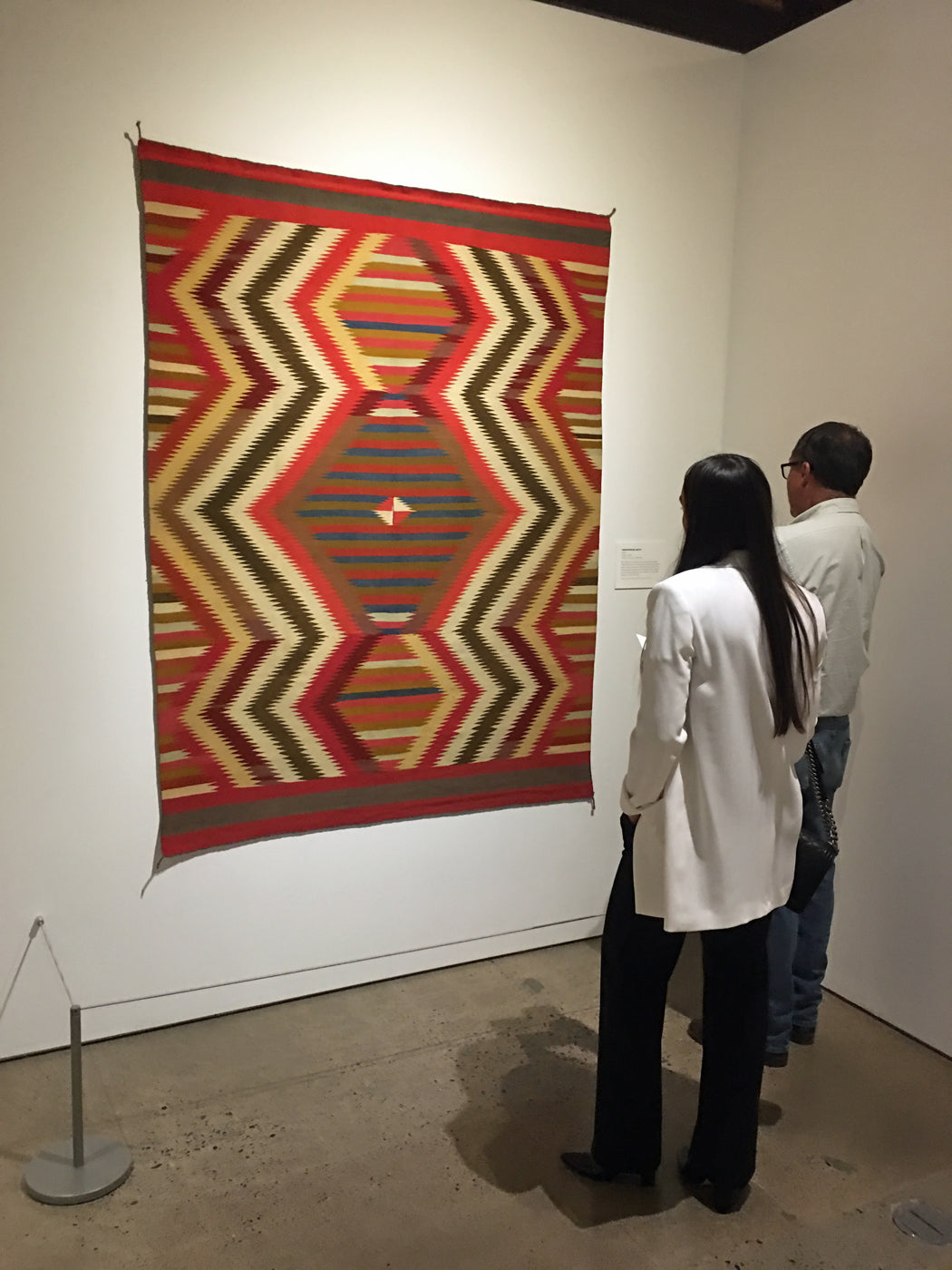
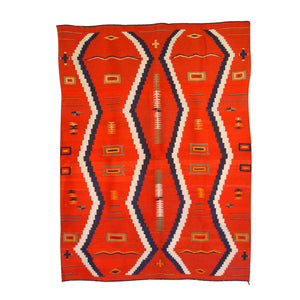
Historic Navajo Serape with Spider Woman Hole: PC 258 : 57″ x 75.5″ (4'9" x 5'11.5")
Product Description

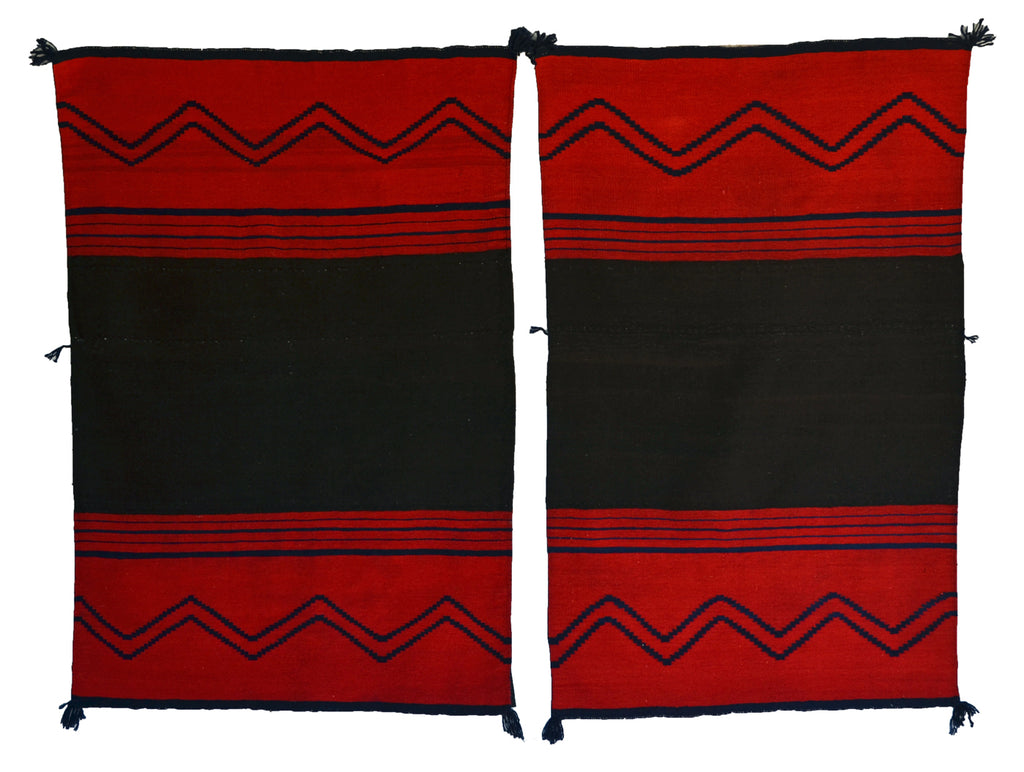
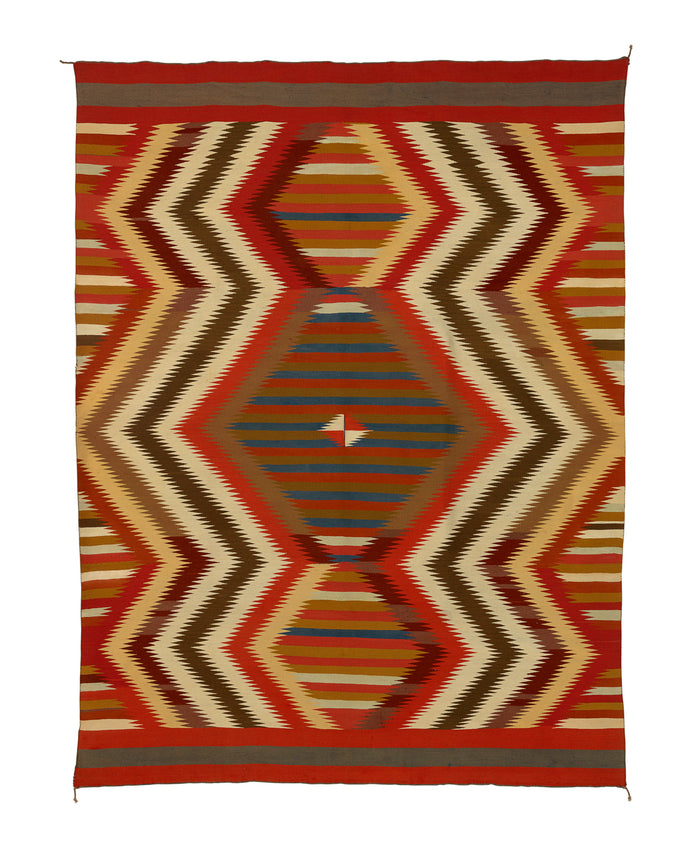
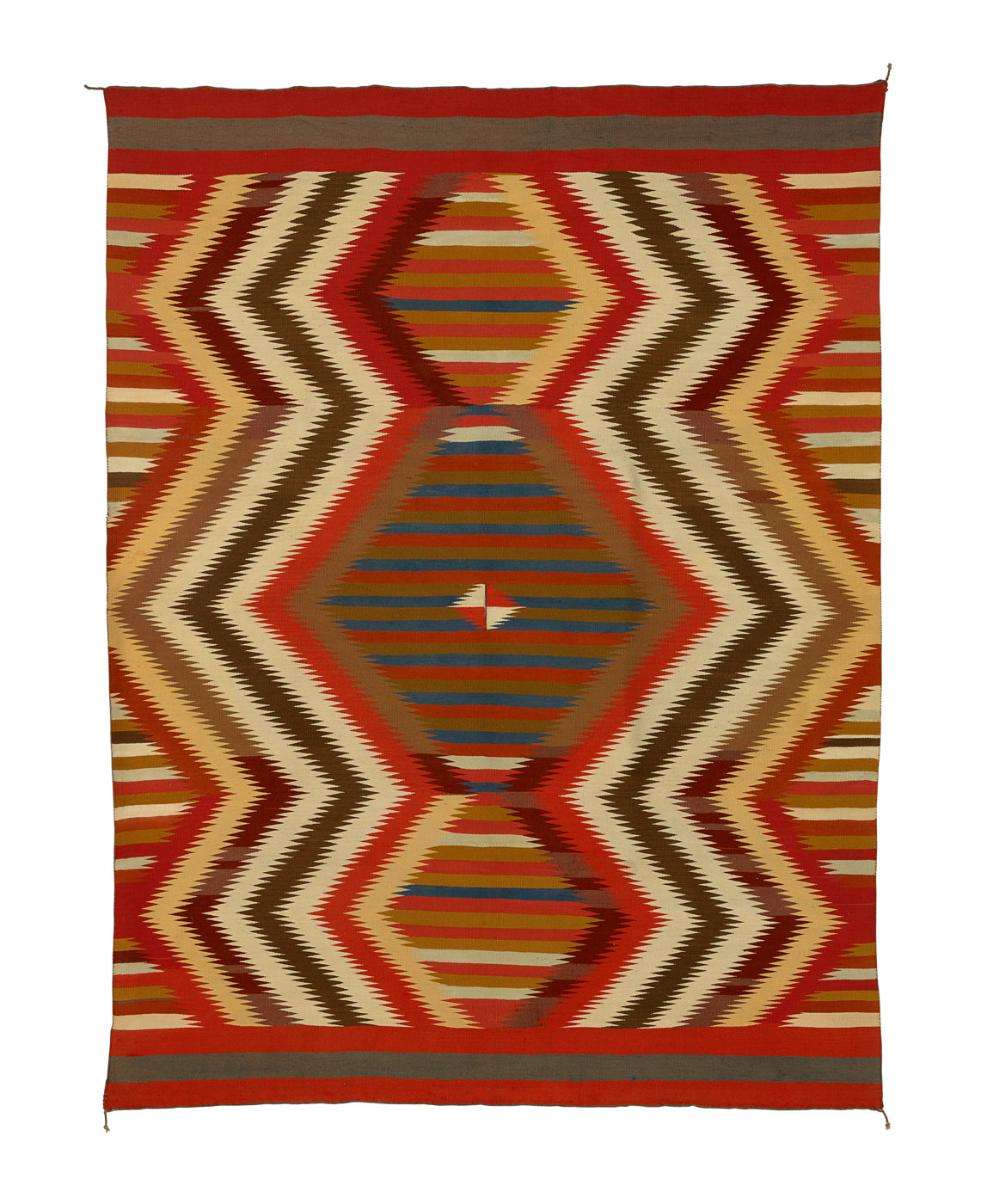
This extremely rare serape blanket with a Spiderwoman hole in its center was likely woven at Bosque Redondo.  This particular palette of colors was only available at Bosque Redondo and Fort Wingate during this time frame.
The Navajo did not have sheep during this time of captivity, so this blanket is made of commercial yarn, three-ply Saxony, which would have come over the Santa Fe Trail.  All natural dyes were used including cochineal red and Indigo blue.  
 Saxony was highly prized in the 18th and 19th centuries, Saxony became famous for exceptionally fine merino sheep, introduced from Spain and carefully bred.  Textiles labeled "Saxony": signaled luxury, refinement, and quality.

The blue is very important because that is the sacred directional color to the Navajo, and this was a time when their thoughts were always directed towards their true home.  Even the warp is Indigo dyed.

In the center of this piece is what's known as a spider woman hole, which some believe the wearer would hide behind and look to see if the enemy was coming.  Spider Woman is the mythological helper and protector of the Dine, and was also the one who taught the first weavers their craft.  This blanket has square plated end tassels, and there are probably only eight other examples like this known.  The design would have been influenced by Spanish blankets.  The Navajos often borrowed from other cultures and adapted it into their own.  

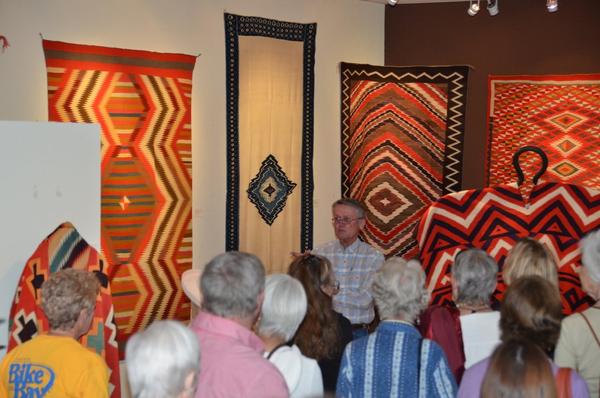
This weaving was part of several exhibitions:

Color Riot! How Color Changed Navajo Textiles April 5,2019 - September 2,2019 at the Heard Museum Phoenix AZ. 
Museum of Fine Arts, St. Petersburg Florida, 9/05/2020 -3/15/2021
Montclair Art Museum, New Jersey.  9/10/2021 - 01/02/2022

One Trader's Legacy: Steve Getzwiller Collects the West :  Desert Caballeros Western Museum November 18, 2017 to June 3, 2018.  

The Dazzled Eye at the Tucson Desert Art Museum, Tucson Arizona January 4 2017 to May 30 2017.


Style Wearables: Manta, Serape
Weaver Unknown Navajo
Date circa 1865-1870's
Size 57″ x 75.5″ (4'9" x 5'11.5")
Item # PC 258
Learn more about wearable weavings

Contact us for more information, pricing or to order – steve@navajorug.com or 520-455-5020 -- We will be glad to help you!

A unique blend of history, Native American culture and storytelling make these weavings an art like no other. 

Maximum quantity available reached.
Name:*
Email:*
Message: *
* Required Fields

Related Products